Fastest
Eureka on the web
When you want the answer in the next five minutes.
The agent works the prompt against patents and technical literature, citing every source.
Run your analysis now →Filing growth compares 2021 (34 records) with 2024 (30) — a three-year span. 2024 is the most recent year we treat as complete: publication lags filing by roughly 18 months, so 2025 onwards are still filling in and any growth rate that ends there would understate the field. Top-5 share is the combined record count of the five largest assignees divided by all 533 records in scope (CR5), not by the ranked leaders only.
Solid-state fermentation substrate formulation spans the practical variables that determine whether a fermentation run succeeds at scale: substrate particle size, moisture content, nutrient loading, water activity, substrate porosity and inoculum distribution. This landscape pulls 533 published records filed or granted between 2015 and mid-2026 that combine solid-state or solid-substrate fermentation language with at least one of those formulation variables, filtered to microorganism, bioreactor and fermentation-related IPC classes.
The dataset spans agricultural biologicals, food and feed processing, bioremediation and industrial enzyme production, all bound by the same underlying engineering problem: how to control a heterogeneous solid matrix well enough to get a repeatable fermentation outcome. Publication lags filing by roughly 18 months, so the 2025 and 2026 counts in any trend view are still filling in and should be read as provisional.
Two views of the same 533-record dataset: how filing activity has moved year over year, and which IPC subclasses carry the claim weight. Because a single record can carry several IPC codes, the composition shares add up to more than 100% of records.
Filings peaked at 85 in 2017 and have since settled lower; the complete-year comparison of 34 filings in 2021 against 30 in 2024 (a 12% decline) is the most recent reliable read, since 2025–2026 counts are still being published.
C12N (microorganisms and genetic engineering) touches 78.4% of the 533 records, well ahead of C12M bioreactor apparatus at 33.6% and C12P fermentation chemistry at 23.1%. Food (A23L, 16.9%), agrochemical (A01N, 16.3%), feed (A23K, 7.9%) and water treatment (C02F, 6.8%) applications sit further down, marking where the underlying microbial and reactor art has been claimed more heavily than its downstream uses.
Shares are the percentage of the 533 records in scope. A patent can carry several IPC classes, so the shares add up to more than 100%.
This page is one run against one query. Ask Eureka your own question about solid-state fermentation substrate formulation and every answer comes back with the patent numbers behind it.
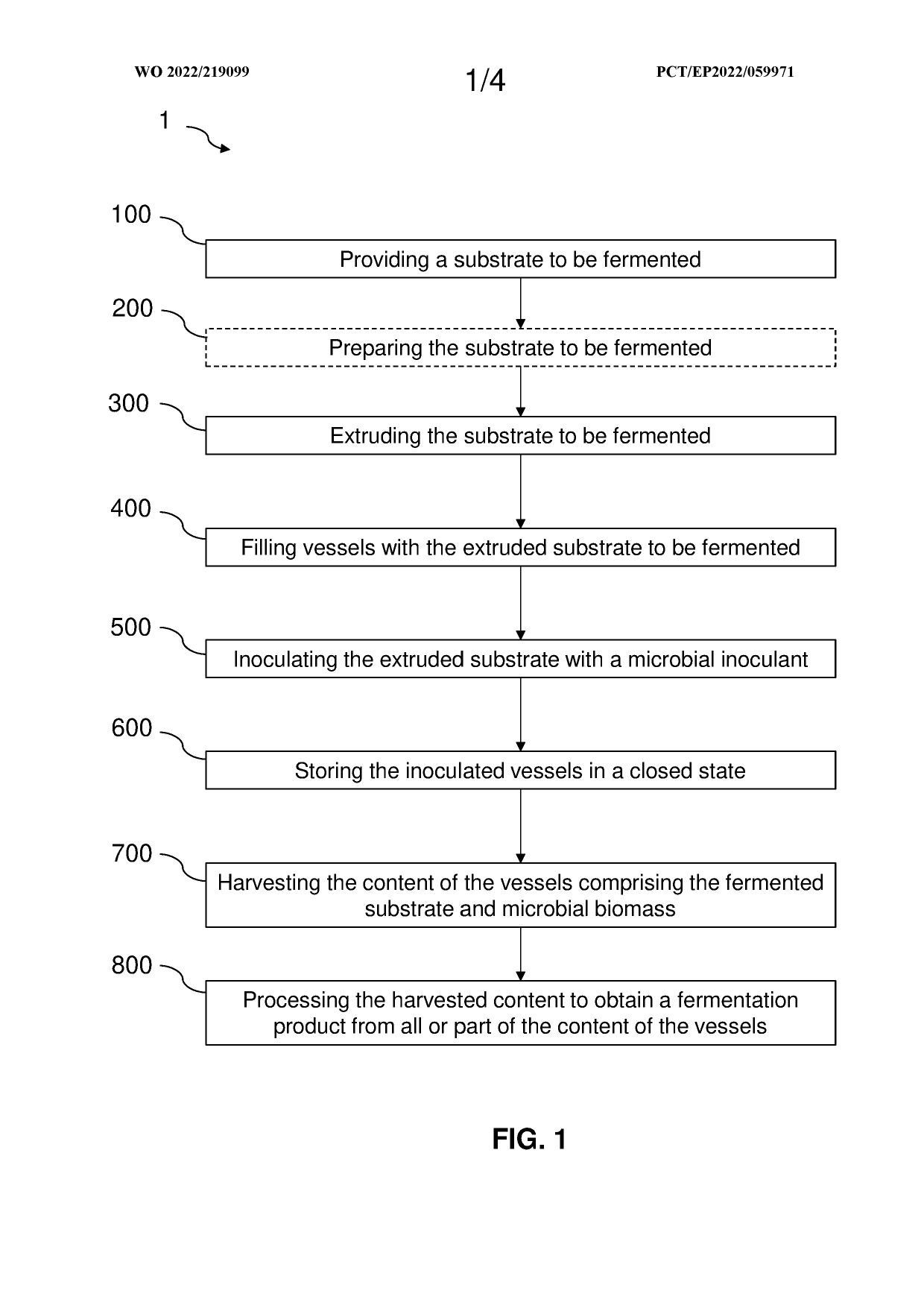
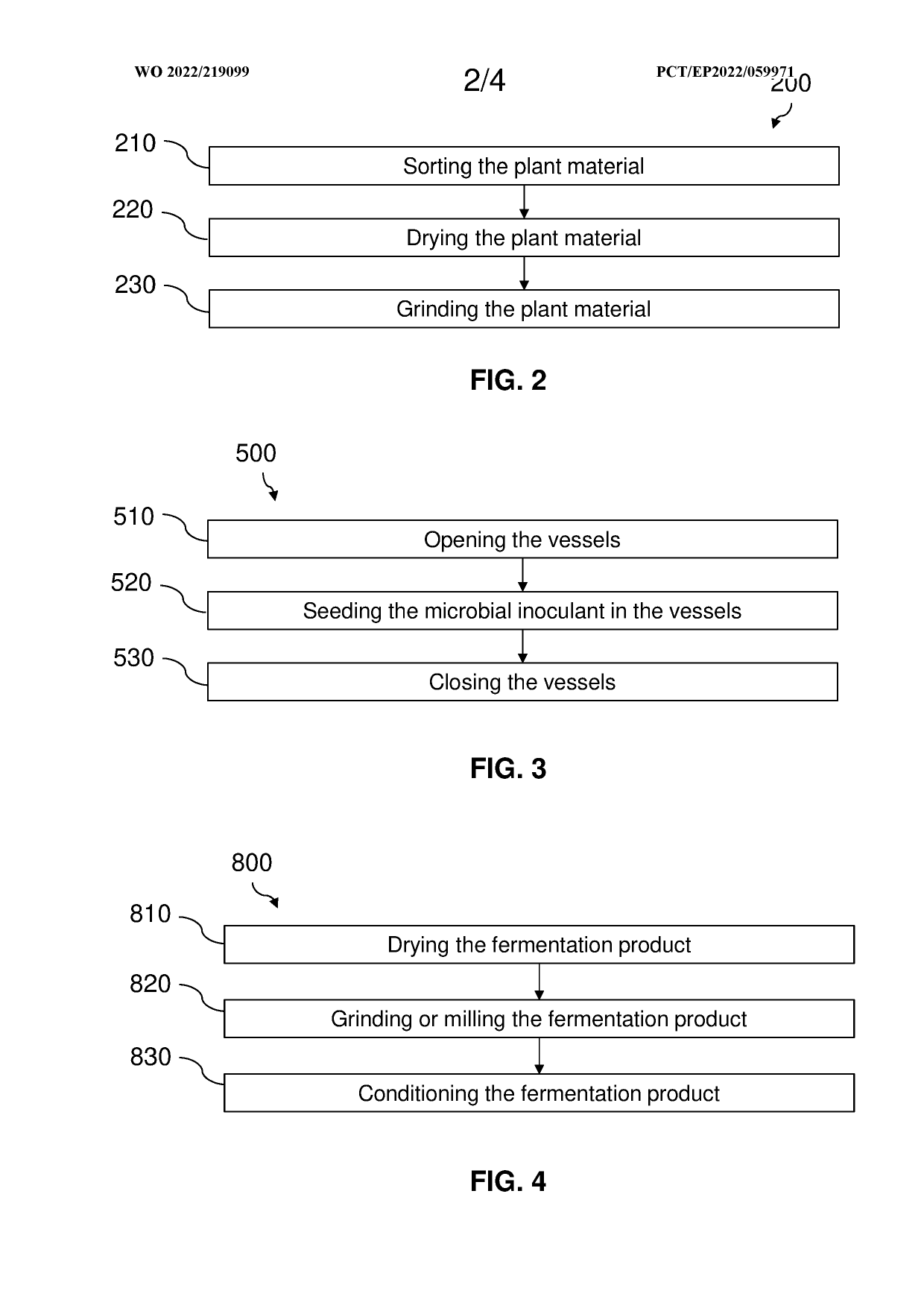
Try EurekaThe filing describes an automated pipeline: extruding a plant-material substrate held above 40% moisture content, filling closed vessels of 100 L or less with the extruded substrate, automatically inoculating it with a microbial inoculant, and storing the sealed, inoculated vessels for a defined fermentation period.Assignee: Green Spot Technologies. Filed 2022-10-20.
| # | Publication no. | Patent title | Citations |
|---|---|---|---|
| 1 | WO2017151684A1 | Filamentous fungal biomats, methods of their production and methods of their use | 102 |
| 2 | US20090117633A1 | Process of Producing Ethanol Using Starch with Enzymes Generated Through Solid State Culture | 90 |
| 3 | US6197573B1 | Solid state fermentation | 85 |
| 4 | US6620614B1 | Solid-state fermenter and method for solid-state fermentation | 73 |
| 5 | US6664095B1 | Solid state fermentation | 67 |
| 6 | US20090162892A1 | Fermentative production of fine chemicals | 43 |
| 7 | WO2010032260A1 | Stacked basket bioreactor for solid state fermentation | 39 |
| 8 | US5670332A | Enzymatic reactions and apparatus for carrying them out | 35 |
| 9 | WO2019089730A1 | Matrix fermentation systems and methods for producing microbe-based products | 33 |
| 10 | US5288634A | Method of increasing the percentage of viable dried spores of a fungus | 32 |
Citation counts reflect influence within this searched corpus and favour older filings; they are not a measure of current commercial importance.
Each row carries its publication number; clicking a row searches Eureka by that number.
When you want the answer in the next five minutes.
The agent works the prompt against patents and technical literature, citing every source.
Run your analysis now →When it has to run inside your own pipeline.
Patent search, landscape analysis and assignee resolution as MCP tools. Drop them into any agent framework, or call REST directly.
Browse MCP servers →Three read-outs from the dataset that matter for deciding where to file, license, or design around.
The five leading assignees account for 207 of the 533 records in scope. Beyond that, the ranking runs to 100 companies with a fifth-place holder at 16 records and a tenth-place holder at 13, meaning most of the field is single- or low-count filers rather than a second tier of large portfolios.
Filings peaked at 85 in 2017 and, on the most recent complete-year comparison, moved from 34 in 2021 to 30 in 2024. That is a real decline, but not a collapse, and 2025-2026 figures are still incomplete due to publication lag.
C12N appears in 78.4% of the 533 records, meaning most applicants claim the microbial or genetic element alongside their process or apparatus claims. Bioreactor apparatus (C12M, 33.6%) is the next densest layer, while downstream application classes such as feed and water treatment are comparatively open.
Eureka can read the same corpus for gaps instead of for coverage: under-claimed branches adjacent to solid-state fermentation substrate formulation, with the prior art for and against each one.
The ranked leaders span agricultural research institutes, national health agencies, and specialist fermentation-technology companies, with a long tail of smaller filers behind them.
The top-ranked assignee holds 102 records, more than the combined total of positions five through ten. That gap suggests a portfolio built around a core platform rather than one-off filings.
Only nine co-assignee pairs appear in the dataset, and one pairing between two research and public-health bodies accounts for 18 co-filed records, far above the next pairs at three each. Most other assignees file independently.
Several of the most active historical assignees show zero filings in the latest tracked year, including the top-ranked filer at a -100% year-on-year change. That is consistent with the broader 2021-2024 decline rather than a sign any single company has exited.
| Assignee | Recent year | YoY |
|---|---|---|
| The Fynder Group Inc | 0 | -100% |
| International Animal Health Products Pty Ltd | 0 | — |
| Empresa Brasileira de Pesquisa Agropecuaria (EMBRAPA) | 0 | — |
| Sustainable Bioproducts Inc | 0 | — |
| Q Power Oy | 0 | — |
| The Government of the United States of America, as represented by the Secretary, Department of Health & Human Services | 0 | — |
| Locus Agriculture IP Co LLC | 0 | — |
| Nestec SA | 0 | — |
The dataset points to specific next steps depending on whether the goal is freedom-to-operate, licensing, or new filing.
With 38.8% of all 533 records held by five assignees, any new substrate-formulation filing should be checked against that concentrated set before drafting claims.
Run a freedom-to-operate checkFeed-grade (A23K) and water-treatment (C02F) applications sit well below the microorganism and reactor classes in filing density, suggesting room for narrower, application-specific claims.
Explore white space with EurekaOne assignee leads the ranked field with 102 of the 533 records in scope, well ahead of the fifth-ranked holder at 16 records and the tenth at 13. The top five assignees combined hold 207 records, or 38.8% of the total, but the ranking extends to 100 companies, most holding only a handful of filings. This means the field has a clear leader but no dominant second tier.
Filings peaked at 85 in 2017 and have since eased; comparing the two most recent complete years, filings moved from 34 in 2021 to 30 in 2024, a 12% decline. Figures for 2025 and 2026 are still incomplete because publication typically lags filing by around 18 months, so the most recent apparent drop should not be read as the final word. The honest read is a mature field with reduced but ongoing activity rather than one that has stopped.
C12N, covering microorganisms and genetic engineering, appears in 78.4% of the 533 records and is effectively the anchor class for this field. C12M bioreactor apparatus (33.6%) and C12P fermentation chemistry (23.1%) are the next most common, meaning most substrate-formulation patents pair a microbial or process claim with an apparatus or chemistry claim. Downstream application classes like animal feed (A23K, 7.9%) and water treatment (C02F, 6.8%) are claimed far less often.
WO2022219099A1, assigned to Green Spot Technologies and filed in October 2022, covers an automated solid-state fermentation pipeline: extruding a plant-material substrate held above 40% moisture content, filling closed vessels of 100 L or less, automatically inoculating the extruded substrate, and storing the sealed vessels for fermentation. The claims tie specific moisture and vessel-size parameters to an automated inoculation step. Anyone building an automated, closed-vessel solid-state fermentation process at a similar scale should review this filing directly rather than relying on the abstract alone.
The IPC composition data shows animal feed and water-treatment applications are claimed far less densely than the core microorganism and bioreactor classes, at 7.9% and 6.8% of records respectively against 78.4% for C12N. Specific formulation variables such as inoculum distribution uniformity and porosity engineering for feed-grade output also appear underrepresented relative to moisture and particle-size claims. A narrower filing tied to one of these application branches, rather than a broad microorganism or process claim, is more likely to clear the existing claim density.
Go past this page: query the whole solid-state fermentation substrate formulation corpus yourself, in your own scope.
Every answer comes back with patent numbers you can open.
Disclaimer. This page is generated from Patsnap Eureka data drawn from a limited snapshot of global patent and scientific-literature records, and is provided for general information and reference only.
Patent data carries inherent limitations: recent filings (typically the most recent 18–24 months) are under-counted due to standard publication lag; counts may be reported at either a patent-family or a patent-record basis and are not always directly comparable; classification, applicant-name, and citation data may contain errors, duplicates, or omissions; and the underlying search query defines and constrains the scope shown. As a result, the analysis may be incomplete or inaccurate and may not reflect the full technology landscape.
Nothing on this page constitutes an exhaustive prior-art, novelty, freedom-to-operate, or validity search, nor does it constitute legal, financial, investment, or professional advice, and it should not be relied upon as such. Any patent, commercial, or strategic decision should be verified independently and reviewed with qualified patent, legal, and domain professionals. Patsnap makes no warranties, express or implied, as to the accuracy, completeness, or fitness for any particular purpose of the information presented.
Machine translation. Assignee and organisation names originally recorded in Chinese, Japanese or Korean have been rendered into English by an AI translation step so that the tables stay readable. These renderings are best-effort and may not match a company's registered English name; the original name is what the underlying patent record carries, and it is what any Eureka query launched from this page uses.
Help us improve
Something wrong, out of date, or missing on this page? Tell us and it goes straight to the team that maintains it.
This page