Fastest
Eureka on the web
When you want the answer in the next five minutes.
The agent works the prompt against patents and technical literature, citing every source.
Run your analysis now →This review covers patent filings and publications matching data stream processing, exactly-once semantics and event time concepts, combined with mechanisms such as watermark generation, late event handling, checkpoint barriers, state backends, event reprocessing and checkpoint intervals. The scope spans publications from 2015 through the 2026-07-31 data cut-off, and the corpus in view totals 21 published records.
This is a small, tightly-drawn corpus rather than a broad category sweep. That makes it well suited to identifying exactly which named entities and inventors hold the core recovery and checkpointing art, and where the surrounding claim space is still open, but it means every figure here should be read as a signal from a focused set of documents, not a market-wide census.
Pick a task. Every answer cites the patents behind it.
Two views of the same 21-record corpus: filings by year, and the IPC subclasses those filings carry. Because a single record can be tagged with more than one subclass, the composition shares sum to more than 100% of records.
The trend runs from a 2017 high of 12 filings down to 1 in the most recent, partial year. With fewer than four complete years available once publication lag is accounted for, no growth rate can be stated from this data — but the shape shows early concentration of activity around 2017 rather than a steady build.
G06F (electric digital data processing) carries 81.0% of the 21 records in scope, with G06Q (business/commerce data processing) a distant second at 19.0%. A63F, G06N, G08C and H04L each appear on only one to three records — these are the edges of the claim map, not its center.
Shares are the percentage of the 21 records in scope. A patent can carry several IPC classes, so the shares add up to more than 100%.
This page is one run against one query. Ask Eureka your own question about stream processing semantics and every answer comes back with the patent numbers behind it.
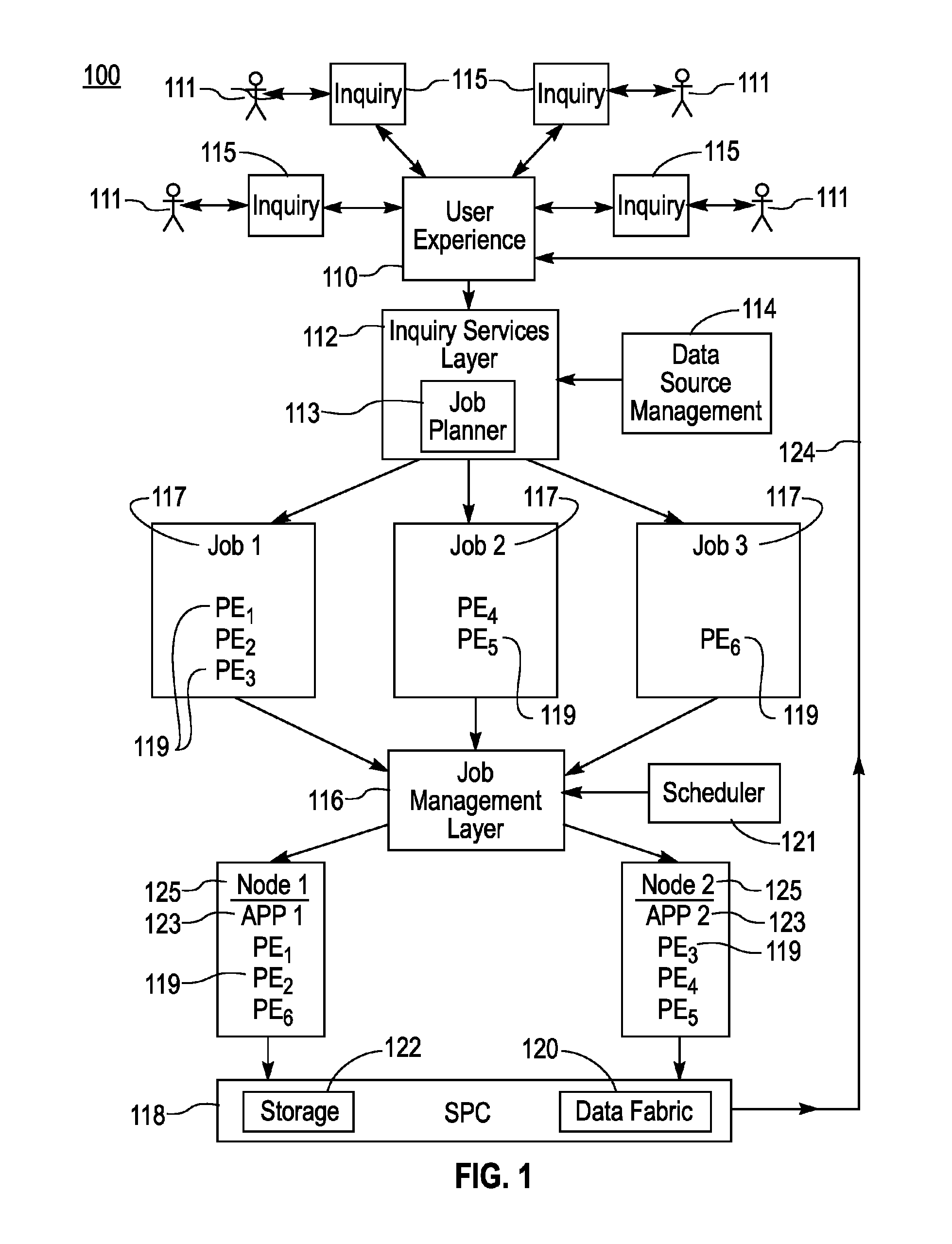
Try EurekaA failure recovery framework to be used in cooperative data stream processing is provided that can be used in a large-scale stream data analysis environment. Failure recovery supports a plurality of independent distributed sites, each having its own local administration and goals. The distributed sites cooperate in an inter-site back-up mechanism to provide for system recovery from a variety of failures within the system. Failure recovery is both automatic and timely through cooperation among sites. Back-up sites associated with a given primary site are identified.Filed by International Business Machines Corporation, granted 2012-07-10 as US8219848B2.

| # | Publication no. | Patent title | Citations |
|---|---|---|---|
| 1 | US20100293532A1 | Failure recovery for stream processing applications | 176 |
| 2 | US20080256384A1 | Mechanism for Recovery from Site Failure in a Stream Processing System | 171 |
| 3 | US20080253283A1 | Methods and Apparatus for Effective On-Line Backup Selection for Failure Recovery in Distributed Stream Proce… | 70 |
| 4 | US8219848B2 | Mechanism for recovery from site failure in a stream processing system | 34 |
| 5 | US8949801B2 | Failure recovery for stream processing applications | 25 |
| 6 | US10623281B1 | Dynamically scheduled checkpoints in distributed data streaming system | 14 |
| 7 | US8225129B2 | Methods and apparatus for effective on-line backup selection for failure recovery in distributed stream proce… | 11 |
| 8 | CN120803623A | 一种基于Flink的智能数据流处理系统及其实现方法 | 5 |
| 9 | US20170322986A1 | Scalable real-time analytics | 5 |
| 10 | WO2017191295A1 | A method and apparatus for processing data | 2 |
Citation counts reflect influence within the searched corpus and skew toward older records; they are not a measure of current commercial relevance.
Patent titles are shown in the language they were filed in, not translated, so that each record stays verifiable against the original filing — a translated title will not match in Eureka or in any national register. Each row carries its publication number; clicking a row searches Eureka by that number.
When you want the answer in the next five minutes.
The agent works the prompt against patents and technical literature, citing every source.
Run your analysis now →When it has to run inside your own pipeline.
Patent search, landscape analysis and assignee resolution as MCP tools. Drop them into any agent framework, or call REST directly.
Browse MCP servers →The most-cited documents in this corpus all trace back to inter-site failure recovery for stream processing, filed well before the current wave of stream engines existed as commercial products. That has practical consequences for anyone drafting claims in this space today.
The five most-cited records in this corpus, led by a 176-citation filing on failure recovery for stream processing applications, all address site failure and back-up mechanisms. This cluster predates today's open-source stream engines and forms the prior-art floor that later filings must design around.
With 17 of 21 records carrying a G06F classification, the core digital-data-processing space is dense. Filers exploring watermark generation or checkpoint mechanisms should expect to find prior art here first, regardless of which downstream application they target.
Filing volume peaked in 2017 and has not returned to that level since, with only 1 filing recorded in the most recent, partial year. Because publication lags filing by roughly 18 months, the last one to two years understate true activity, but the multi-year decline from the 2017 peak is a real pattern, not an artefact.
Eureka can read the same corpus for gaps instead of for coverage: under-claimed branches adjacent to stream processing semantics, with the prior art for and against each one.
The assignee ranking returned by this dataset covers 10 companies and individual filers, led by one entity with 7 records. Below that leader the field drops off quickly: fifth place holds 2 records and tenth place holds 1, consistent with a long tail of single-filing entrants rather than a second corporate cluster.
The top-ranked assignee holds 7 of the records in this corpus, well ahead of the rest of the ranked list. No second company approaches that volume, which points to a single organisation having built out the core failure-recovery and site-cooperation art early, with everyone else filing individually or in small numbers.
Six co-assignee pairs appear in the data, with three of them sharing one inventor in common across different pairings. This suggests a small group of individual filers collaborating repeatedly rather than large corporate co-filing arrangements.
In the most recent year, the only filer recorded with activity is a single institutional entrant; the historical leader and the other named corporate and individual assignees show zero filings in that year. Recency should be read cautiously given publication lag, but the leader's momentum has visibly paused.
| Assignee | Recent year | YoY |
|---|---|---|
| NOIDA INST OF ENG & TECH | 1 | — |
| Ab Initio Technology LLC | 0 | — |
| Jin.com Limited | 0 | — |
| International Business Machines Corporation | 0 | — |
| WU KUN LUNG | 0 | — |
| JACQUES DA SILVA GABRIELA | 0 | — |
| GEDIK BUGRA | 0 | — |
| ANDRADE HENRIQUE | 0 | — |
A 21-record corpus is small enough to read in full, but that also means conclusions should be checked against the primary documents before they inform a filing or freedom-to-operate decision.
The 7-record leader's portfolio anchors this space; reading its independent claims in full will show how tightly the failure-recovery and back-up-site mechanisms are actually bounded.
Explore the leader's portfolio in EurekaThe G06N, H04L and G08C overlaps each carry only one record. Drafting a first claim against one of these and running it through prior-art search will show how open the space really is.
Draft and search a claim in EurekaIn this dataset, one assignee leads with 7 of the 21 records in scope, well ahead of the rest of the ranked list of 10 companies and individual filers. The next positions drop off quickly, with fifth place holding 2 records and tenth place holding just 1. This pattern points to a single organisation having built out the core recovery and checkpointing art early, with a long tail of smaller or single-filing entrants rather than several competing corporate portfolios.
In this corpus, exactly-once semantics filings sit alongside watermark generation, checkpoint barriers and state backend mechanisms, all aimed at ensuring a stream processing system produces correct results despite failures or reprocessing. The most-cited records in the dataset frame this as a failure-recovery problem: identifying back-up sites, detecting failures, and resuming processing without duplicating or dropping events. Anyone drafting in this area should expect dense prior art in the underlying recovery mechanisms even if the specific exactly-once framing is new.
The data shows 2017 as the peak year with 12 filings, higher than any other year in the 2015–2026 window. This dataset alone cannot establish the cause, but the timing coincides with growing commercial interest in stream processing infrastructure during that period. Filing counts in the years since have not returned to that level, and the most recent years are likely understated because publication typically lags filing by around 18 months.
US8219848B2, assigned to International Business Machines Corporation and granted 2012-07-10, covers a failure recovery framework for cooperative data stream processing across independent distributed sites. It describes identifying back-up sites associated with a primary site and using an inter-site back-up mechanism so that failures, including application failures on processing nodes, trigger automatic and timely recovery. It is one of the most-cited records in this corpus, meaning many later filings in stream processing recovery are likely to reference or design around it.
The clearest gaps sit outside the dominant G06F class, which alone carries 81.0% of the 21 records in scope. Classes like G06N (AI-based computing), H04L (digital transmission) and G08C (measured-value transmission) each appear on only one record, and G06Q and A63F carry a handful more. These slivers suggest that applying AI-assisted watermarking, transport-layer checkpoint signalling, or measured-value stream handling to the core recovery problem remains largely unclaimed in this dataset.
Go past this page: query the whole stream processing semantics corpus yourself, in your own scope.
Every answer comes back with patent numbers you can open.
Disclaimer. This page is generated from Patsnap Eureka data drawn from a limited snapshot of global patent and scientific-literature records, and is provided for general information and reference only.
Patent data carries inherent limitations: recent filings (typically the most recent 18–24 months) are under-counted due to standard publication lag; counts may be reported at either a patent-family or a patent-record basis and are not always directly comparable; classification, applicant-name, and citation data may contain errors, duplicates, or omissions; and the underlying search query defines and constrains the scope shown. As a result, the analysis may be incomplete or inaccurate and may not reflect the full technology landscape.
Nothing on this page constitutes an exhaustive prior-art, novelty, freedom-to-operate, or validity search, nor does it constitute legal, financial, investment, or professional advice, and it should not be relied upon as such. Any patent, commercial, or strategic decision should be verified independently and reviewed with qualified patent, legal, and domain professionals. Patsnap makes no warranties, express or implied, as to the accuracy, completeness, or fitness for any particular purpose of the information presented.
Machine translation. Assignee and organisation names originally recorded in Chinese, Japanese or Korean have been rendered into English by an AI translation step so that the tables stay readable. These renderings are best-effort and may not match a company's registered English name; the original name is what the underlying patent record carries, and it is what any Eureka query launched from this page uses.
Help us improve
Something wrong, out of date, or missing on this page? Tell us and it goes straight to the team that maintains it.
This page