




- PatentBench-Novelty Search
- Methodology
- Use Cases
Understanding Novelty Search
Novelty search is a key patent task that involves systematically identifying prior art worldwide to determine whether a technical solution is new and inventive under patent law.
It plays a critical role throughout the innovation process, including:
R&D planning: guiding the direction and feasibility of new developments
Pre-filing: verifying that an invention is patentable before submission
Patent examination: helping examiners assess the novelty of applications
Key Findings
This benchmark evaluates seven AI tools for patent novelty search: Patsnap's Novelty Search AI Agent, Claude Opus 4.8 (with web search), Perplexity Pro (with web search), Kimi-k3 (with web search), DeepSeek-v4-flash (with web search), ChatGPT 5.6 (with web search), and Gemini 3.1 Pro (with web search).
The evaluation uses a curated cross-jurisdiction patent family dataset of 340 test samples. Each sample contains a problem statement and a standard answer: the family set of X references cited by examiners across different patent offices. This design creates a practical benchmark answer that closely reflects real-world novelty search requirements.
Benchmark results show that Patsnap's Novelty Search AI Agent remains the leading tool, with an 85% X Hit Rate and a 37% X Recall Rate within the top 100 results. Among general-purpose AI tools, ChatGPT 5.6 performed best, reaching a 71.76% X Hit Rate and a 30.51% X Recall Rate. Overall, domain-specific AI tools still show clear value in patent novelty search.
The evaluation dataset is evenly distributed across IPC classifications, covering both mainstream technologies and niche domains. In terms of language, 68% of the data is in English and 32% of the data is in Chinese, ensuring the model performs well across multilingual patent content.
For receiving-office distribution, applications from United States (US) and China (CN) each make up about 32%, while those from the European Patent Office (EP) and WIPO (WO) each account for roughly 18%. This balanced mix reflects the different examination styles across major patent jurisdictions and ensures more realistic, globally representative evaluation.
Language distribution of patent texts in 340 test samples

Distribution of IPC samples across 340 test samples

Note: Percentages may not sum to 100% due to rounding to one decimal place.
Distribution of receiving offices for 340 test samples

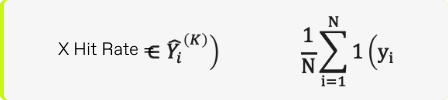
1) X Hit Rate
Patsnap’s Novelty Search AI Agent successfully identified at least one relevant X document in 85% of test cases—an essential capability for speeding up decision-making in patent examination and early-stage R&D.

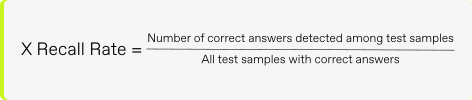
2) X Recall Rate
Patsnap’s Novelty Search AI Agent retrieved 37% of all relevant X documents, enabling more thorough analysis and more informed patent claim drafting.
A high X Recall Rate is key during R&D planning and before filing a patent. Patsnap’s Novelty Search AI Agent helps teams—whether in-house researchers, patent professionals, or external agents—find more relevant X documents. This supports better technical decisions and stronger patent claims, increasing the chances of patent approval.

3) Typical Test Result Sample
In this test, the patent specification, or problem statement, was submitted to each AI tool. The returned results were evaluated against a predefined standard-answer set of X references.
The sample below shows how the benchmark evaluates the returned patent references. Green references are hits in the standard-answer family set, and the bottom rows calculate X Hit Rate and X Recall Rate directly from those hits.
A single-sample benchmark test


In this sample, Patsnap's Novelty Search AI Agent identified three of the four relevant patent families, achieving a 100% X Hit Rate and a 75% X Recall Rate. Claude Opus 4.8 returned eight results in this sample; its two hits appear at positions 3 and 8, identifying two of the four relevant families and achieving a 100% X Hit Rate and a 50% X Recall Rate for this sample. ChatGPT 5.6 identified two of the four relevant families, achieving a 100% X Hit Rate and a 50% X Recall Rate for this sample. Perplexity Pro identified one relevant family, while DeepSeek-v4-flash, Kimi-k3, and Gemini 3.1 Pro did not identify a relevant family in this example.
These sample-level results are illustrative. The overall benchmark conclusions are based on the full dataset of 340 cross-jurisdiction patent family samples.
Future Research
Future benchmarks will continue to expand the dataset and refine the evaluation methods for greater accuracy, coverage, and representativeness. As the dataset grows, the benchmark will provide a more robust view of how AI tools perform in professional patent novelty search.