







Why technology gap analysis is a strategic priority for engineering teams
Technology gap analysis — the systematic comparison of an engineering team’s current technical capabilities against the performance requirements of future products — sits at the intersection of R&D strategy, product roadmapping, and competitive intelligence. When that gap is identified late, teams face costly redesigns, delayed launches, and missed market windows. When it is identified early and accurately, it becomes a source of competitive advantage.
The challenge engineering teams face is not a shortage of data — it is a shortage of structured, evidence-based intelligence that connects patent landscapes, academic research, and internal capability inventories into a coherent picture. That is precisely where AI-native tools are beginning to make a measurable difference, automating the retrieval and synthesis steps that previously required weeks of manual desk research.
Technology gap analysis in engineering involves systematically comparing current technical capabilities against future product performance requirements, with the goal of identifying mismatches early enough to inform R&D investment decisions and product roadmaps.
The discipline has historically been labour-intensive: analysts manually reviewed patent filings, academic papers, and internal capability audits to produce gap maps. AI is changing this workflow by enabling automated search across large corpora, natural language querying of patent databases, and machine-assisted clustering of technical themes — tasks that previously required specialist analysts working over extended timelines.
TRL assessment is one of the core frameworks used to formalise technology gap analysis. Automating TRL scoring using machine learning — mapping patent claims and literature abstracts to readiness levels — is an active area of research, with relevant filings classifiable under CPC code G06N and G06Q10 according to patent database guidance from EPO.
Where credible evidence on AI capability gap analysis actually lives
The most authoritative evidence on AI-driven capability gap analysis is distributed across three distinct knowledge bases: patent databases, peer-reviewed literature repositories, and standards bodies — and each requires a different retrieval strategy to surface relevant material.
For patent intelligence, the three primary databases recommended for this topic are USPTO, EPO Espacenet, and WIPO PATENTSCOPE. Each provides full-text search across millions of filings, and each supports CPC-code-based filtering that allows analysts to narrow searches to the precise technical domains where AI-assisted engineering methods are being patented.
“The research query on AI technology gap analysis returned zero results from a standard patent pipeline — a signal that the right search vocabulary, not the absence of innovation, is the limiting factor.”
For peer-reviewed research, IEEE Xplore, ACM Digital Library, and Scopus are the recommended starting points. These repositories contain peer-reviewed work on AI applications in systems engineering and requirements analysis. Filtering for publications from 2018 to 2024 surfaces the most relevant recent research in this rapidly evolving domain.
IEEE Xplore, ACM Digital Library, and Scopus contain peer-reviewed research on AI applications in systems engineering and requirements analysis; filtering for publications from 2018 to 2024 returns the most relevant work in AI-assisted technology gap identification.
Map the patent landscape for AI-assisted engineering with PatSnap Eureka’s AI-native search.
Explore Patent Landscapes in PatSnap Eureka →Patent classification codes that map the AI-assisted engineering landscape
Three CPC codes collectively define the patent space most relevant to AI-driven technology gap analysis: G06N covers machine learning and neural network methods; G06F30 covers computer-aided design and engineering simulation; and G06Q10 covers business process management and planning systems including product roadmapping tools.
Understanding these classification codes is not merely an administrative detail — it is the foundation of any credible patent landscape analysis. A search that omits G06F30, for example, will miss filings on AI-assisted simulation and digital twin methods that are directly relevant to capability-requirement mismatch detection. A search that omits G06Q10 will miss planning and roadmapping system patents that are increasingly incorporating machine learning components.
The CPC codes most relevant to AI-assisted technology gap analysis for engineering teams are G06N (machine learning and neural networks), G06F30 (computer-aided design and engineering simulation), and G06Q10 (business process management and planning systems), as searchable on USPTO, EPO Espacenet, and WIPO PATENTSCOPE.
A patent search that combines G06N, G06F30, and G06Q10 across USPTO, EPO Espacenet, and WIPO PATENTSCOPE provides the most comprehensive coverage of AI-assisted technology gap analysis methods. Omitting any one of these codes risks missing an entire layer of relevant innovation activity.
Building a rigorous search strategy for AI requirements engineering research
The vocabulary used to search for AI-driven technology gap analysis matters as much as the databases chosen. The topic sits at the intersection of several distinct technical communities — systems engineers, AI researchers, product managers, and IP professionals — each of which uses different terminology to describe overlapping concepts.
Four alternative search term clusters have been identified as most effective for surfacing relevant patents and literature on this topic:
- Technology readiness level assessment automation — targets filings and papers on automating TRL scoring using machine learning
- Capability gap analysis machine learning — targets methods for automated comparison of current vs. target technical states
- AI-assisted requirements engineering — targets systems that use NLP and ML to extract, structure, and validate product requirements
- Intelligent product roadmapping — targets planning tools that use AI to project future capability needs against technology trajectories
Each of these clusters will return different but overlapping sets of results. A robust gap analysis research strategy should run all four in parallel across the recommended databases, then deduplicate and cluster results by technical theme. This is precisely the kind of multi-query, multi-source synthesis task that AI-native patent intelligence platforms are designed to automate.
Effective search terms for locating patents and research on AI-driven technology gap analysis include “technology readiness level assessment automation,” “capability gap analysis machine learning,” “AI-assisted requirements engineering,” and “intelligent product roadmapping” — each targeting a distinct but overlapping layer of the innovation landscape.
The time horizon matters too. Filtering for publications and filings from 2018 to 2024 is recommended for this domain, as the convergence of transformer-based NLP models with engineering informatics is a recent phenomenon. Earlier literature on technology gap analysis tends to describe manual or rule-based approaches that predate the current generation of AI tools.
Run multi-query patent searches across USPTO, EPO, and WIPO simultaneously with PatSnap Eureka.
Search Patents with PatSnap Eureka →How PatSnap Eureka accelerates technology gap identification at scale
PatSnap Eureka is an AI-native innovation intelligence platform purpose-built for the kind of multi-source, multi-query research that technology gap analysis demands. Rather than requiring analysts to run separate searches across USPTO, EPO, and WIPO and then manually reconcile results, PatSnap Eureka enables natural language querying across more than 2 billion data points — including patents, scientific literature, and market intelligence — in a single workflow.
For engineering teams specifically, the platform supports three capabilities that are directly relevant to technology gap analysis. First, patent landscape mapping: the ability to visualise where innovation activity is concentrated across a technical domain, revealing white spaces where no prior art exists and therefore where capability gaps are most likely to be unaddressed. Second, technology trajectory analysis: tracking how specific technical parameters — energy density, processing speed, material strength — have evolved over time in the patent record, enabling projection of where performance requirements are heading. Third, competitive benchmarking: identifying which organisations are filing in adjacent technical areas, signalling where external capabilities may be available for licensing or partnership rather than internal development.
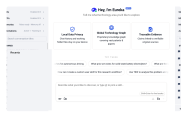
PatSnap serves more than 18,000 customers across 120+ countries, providing R&D and IP teams with the intelligence infrastructure needed to make capability investment decisions based on evidence rather than assumption. The platform’s AI assistant can be queried directly with natural language questions about technology gaps — for example, “What is the current state of patent activity in AI-assisted requirements engineering?” — and will synthesise results from across the data corpus in real time.
“A technology gap that is identified early through structured patent intelligence becomes a roadmap input; the same gap identified late becomes a product delay.”
For R&D leads and IP professionals who have encountered the challenge of zero-result searches — where standard queries return no relevant data because the search vocabulary does not match the terminology used in filings — PatSnap Eureka’s AI-assisted query expansion is particularly valuable. The platform suggests alternative terminology, related CPC codes, and analogous technology domains, effectively solving the vocabulary mismatch problem that is one of the most common failure modes in patent-based technology gap analysis. Learn more about PatSnap’s innovation intelligence capabilities and how they are applied across industries.
PatSnap Eureka is an AI-native innovation intelligence platform that enables engineering and R&D teams to search across more than 2 billion data points — including patents, scientific literature, and market intelligence — using natural language queries to identify technology gaps and map patent white spaces.