




Overview
The Patsnap PatentBench is a benchmark for patent tasks in real-world scenarios. It evaluates the performance of AI tools against curated test samples each consisting of a "test question" and a "standard answer" that closely represent the ideal references used in actual patent work.
Each benchmark is based on hundreds of carefully selected real-world cases, covering different patent tasks, jurisdictions, and industries. The Patsnap PatentBench currently covers three patent workflows:
Novelty Search - a key patent task that involves systematically identifying prior art worldwide to determine whether a technical solution is new and inventive under patent law.
Design FTO Search - a process of searching globally registered design patents to determine whether a product's appearance infringes on existing design patent rights.
FTO Search - an analysis to determine whether a product or process potentially infringes valid claims of existing utility patents in target markets.
Novelty Search
Performance Comparison
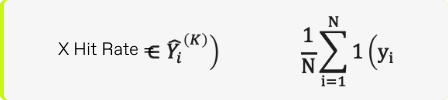
X Detection Rate (Top 100)
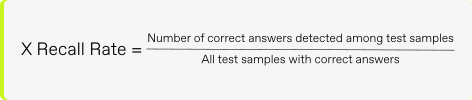
X Recall Rate (Top 100)
Design FTO Search
Performance Comparison
High-Risk Patent Hit Rate (Top 200)
PRES Score
FTO Search
whether a technology can be freely practiced without infringing others' patent rights.