







Pharma Competitive Intelligence: A Practical Operating Framework
A practical operating framework for turning pipeline, clinical, regulatory, scientific, patent, and company signals into decisions.
Pharma competitive intelligence is the disciplined process of monitoring competitors and the external environment, interpreting what has changed, and explaining what that change could mean for a specific business decision. The useful output is not a larger collection of alerts. It is a traceable, time-bound assessment that connects evidence to an implication, confidence level, and next action.
This guide focuses on the operating system behind that output: the questions to start with, the signal domains to monitor, the workflow for turning events into intelligence, and the controls that keep conclusions reviewable.
What pharma competitive intelligence should produce
A strong CI output answers four questions: What happened? What changed from the previous baseline? Why might it matter to us? What should we verify or do next? It separates reported facts from analyst interpretation and links each material statement to a dated source.
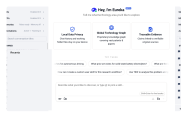
For teams monitoring selected targets and indications, Pulse in Eureka Life Sciences provides customized weekly briefs that can cover newly published patent alerts, company activity, lead-compound intelligence, and druggability analysis.1 That can support signal monitoring, but the team still owns the decision context, source review, and interpretation.
Competitive data is an input. Competitive intelligence is a documented judgment about what the data changes for a defined decision.
Start with the decision, not the database
A broad request such as “track oncology competitors” creates noise because it does not define what counts as relevant change. Begin with a decision and a time horizon, then work backward to the entities, events, and sources that could change that decision.
Four useful question patterns
- Asset or indication: Has the probability, timing, or differentiation of a competing program changed?
- Portfolio: Is a mechanism, modality, biomarker, or patient segment becoming more or less crowded?
- Business development: Which assets or companies may fit a licensing, partnership, or acquisition thesis?
- IP and entry: Which patent, regulatory, or exclusivity events may affect freedom to operate, launch timing, or negotiating leverage?
Write the question before configuring a feed. Then define the monitored entities, the events that would count as a material change, the decision owner, and the deadline. A one-page scope prevents a monitoring program from expanding every time a new source appears.
Build a five-domain signal map
No single source shows the whole competitive picture. The same asset may appear under a development code, generic name, brand name, company alias, target, or trial identifier. A useful map combines domains and preserves those connections.
Track trial status, phase, design, endpoints, enrollment, geography, sponsor, and material record changes. ClinicalTrials.gov makes public study records available through downloads and an API, with weekday data refreshes.2
Use Drugs@FDA for approval materials, the Orange Book for approved drugs and listed patent or exclusivity information, and the Purple Book for licensed biological products.345
Monitor peer-reviewed literature, conference disclosures, posters, and primary company communications. Record whether a result is preclinical, interim, peer reviewed, or only reported by the sponsor.
Track applicants, inventors, priority dates, family members, legal status, claims, and technical concepts. WIPO PATENTSCOPE provides access to published PCT applications and participating national or regional collections.6 For a deeper workflow, see Patsnap’s guide to linking competitor pipelines to patent families.
A source record may be incomplete, delayed, corrected, or differently scoped from another source. Capture the retrieval date and source version; do not treat absence of disclosure as evidence that an event did not occur.
Turn signals into intelligence: a seven-step workflow
- Define the decision and baseline. State what the team believes now, what period is in scope, and what evidence could change that view.
- Create an entity dictionary. Connect company aliases, asset codes, generic and brand names, targets, indications, trial IDs, patent assignees, and former owners.
- Collect with provenance. Save the source, publication or event date, retrieval date, relevant excerpt or field, and stable identifier.
- Normalize the event. Classify it consistently—for example, trial start, endpoint change, patent publication, regulatory decision, licensing event, or discontinuation.
- Compare it with the baseline. Ask what is genuinely new. A repeated press release is not a second event; a changed trial endpoint may be.
- Triangulate material claims. Look for an independent or more authoritative source and explain any conflict. Primary regulatory, registry, patent, and company filings generally deserve priority over summaries.
- Write the implication. Separate fact, inference, confidence, open questions, and recommended follow-up. Name the analyst and review date.
Automated collection and summarization can accelerate monitoring, but entity matches, legal status, scientific meaning, and strategic implications should be checked by qualified reviewers.
Set the right cadence and deliverable
Cadence should follow decision speed and signal volatility. The table below is a practical starting point, not a universal standard.
| Cadence | Best used for | Typical output |
|---|---|---|
| Event driven | Regulatory decisions, pivotal readouts, material transactions, litigation, or launch events | Short alert with source, change, initial implication, and assigned follow-up |
| Weekly | Active targets, indications, assets, or priority competitors | Curated change brief ranked by relevance and confidence |
| Monthly or quarterly | Portfolio, landscape, and strategy review | Pattern analysis, updated assumptions, scenarios, and decision log |
| Decision specific | Diligence, licensing, indication selection, trial design, or launch planning | Deep dive built around the decision criteria and deadline |
A compact intelligence brief
Controls that make CI reusable
Keep facts, interpretations, and scenarios separate
A registry status change is a fact from a named record. A forecast about development timing is an interpretation. A competitor-response plan is a scenario. Labeling these layers prevents an inference from being repeated later as established fact.
Maintain a decision log
Record which intelligence changed an assumption, who approved the change, and when it should be revisited. This turns CI from a stream of updates into organizational memory.
Respect source and legal limits
Use licensed content according to its terms, handle confidential information appropriately, and involve legal, IP, regulatory, medical, or compliance specialists when conclusions enter their domains. Patent status and claim scope in particular require jurisdiction-specific professional review. Patsnap’s overview of patent landscape software can help teams frame a separate evaluation of patent-analysis tools.
Questions to ask during a platform trial
- Coverage: Are the required clinical, regulatory, scientific, patent, and company sources included for the markets in scope?
- Provenance: Can users reach the underlying record and see dates, identifiers, and source context?
- Entity resolution: How are asset aliases, ownership changes, targets, indications, and patent families connected—and corrected?
- Change detection: Can the system distinguish a new event from an edited or repeated record?
- Review workflow: Can analysts annotate, challenge, approve, and version an interpretation?
- Monitoring: Can teams define priority entities and events without creating unmanageable alert volume?
- Output: Can evidence be exported into a traceable brief that fits existing governance?
- Validation: Does a sample set of known events produce accurate, relevant results, including difficult aliases and negative cases?
Use a scored test set drawn from real decisions. A polished demonstration is not a substitute for checking source coverage, traceability, retrieval quality, and analyst effort on your own cases.
Frequently asked questions
What is pharma competitive intelligence?
How is pharmaceutical competitive intelligence different from market research?
Which sources matter most?
How often should pharma CI be updated?
Can AI replace a pharma competitive intelligence analyst?
Sources and verification
- Eureka Life Sciences, Patsnap, accessed July 24, 2026.
- ClinicalTrials.gov API information, U.S. National Library of Medicine, accessed July 24, 2026.
- Drugs@FDA, U.S. Food and Drug Administration, accessed July 24, 2026.
- Orange Book, U.S. Food and Drug Administration, accessed July 24, 2026.
- Purple Book, U.S. Food and Drug Administration, accessed July 24, 2026.
- PATENTSCOPE, World Intellectual Property Organization, accessed July 24, 2026.
- SEC filing search and EDGAR, U.S. Securities and Exchange Commission, accessed July 24, 2026.
Verification note: Public source descriptions and Eureka Life Sciences capability statements were checked against the linked official pages on July 24, 2026. Database coverage, update timing, and product features can change; verify them again for a live implementation.
Build a more focused life sciences monitoring workflow
Explore how Eureka Life Sciences supports research workflows, competitive intelligence, and customized monitoring around priority targets and indications.
Explore Eureka Life Sciences →This article is for general informational purposes and is not legal, regulatory, medical, investment, or commercial advice. Source records and competitive conditions may change after publication.



