Fastest
Eureka on the web
When you want the answer in the next five minutes.
The agent works the prompt against patents and technical literature, citing every source.
Run your analysis now →Diffractive optical elements (DOEs) manipulate light through microstructured surface relief or phase gratings rather than conventional refraction, and they sit at the centre of structured-light projection, waveguide displays and beam-shaping optics. This landscape draws on 1,894 published records filed between 2015 and mid-2026 that combine DOE-specific terminology with diffraction-efficiency and fabrication-tolerance language, filtered to the optical-element, lighting-component and holography IPC classes most relevant to the field.
Because publication lags filing by roughly 18 months, the most recent year in the trend chart understates true filing activity and should be read as a floor, not a ceiling.
Pick a task. Every answer cites the patents behind it.
The record set spans a single filing peak followed by a sustained decline, layered across optics-dominant IPC classes with meaningful secondary activity in imaging and display-adjacent subclasses.
Annual filings rose from 89 in 2017 to a peak of 135 in 2020, then fell back through a midpoint of 56 in 2022 to 8 in the most recent, partial year. The shape points to a technology whose core claim space filled early in the period, rather than one still accelerating.
G02B (optical elements & systems) appears on 99.0% of the 1,894 records, confirming this is fundamentally an optics-classified field. F21V (lighting components, 7.7%), G01B (dimensional measurement, 5.3%), H04N (pictorial communication, 5.3%), G06T (image processing, 4.7%), G03B (photographic apparatus, 4.4%), G06F (digital data processing, 3.7%) and G02F (optical modulation, 3.6%) each mark a smaller but distinct application layer where DOE claims cross into adjacent systems.
Shares are the percentage of the 1,894 records in scope. A patent can carry several IPC classes, so the shares add up to more than 100%.
This page is one run against one query. Ask Eureka your own question about diffractive optical elements and every answer comes back with the patent numbers behind it.
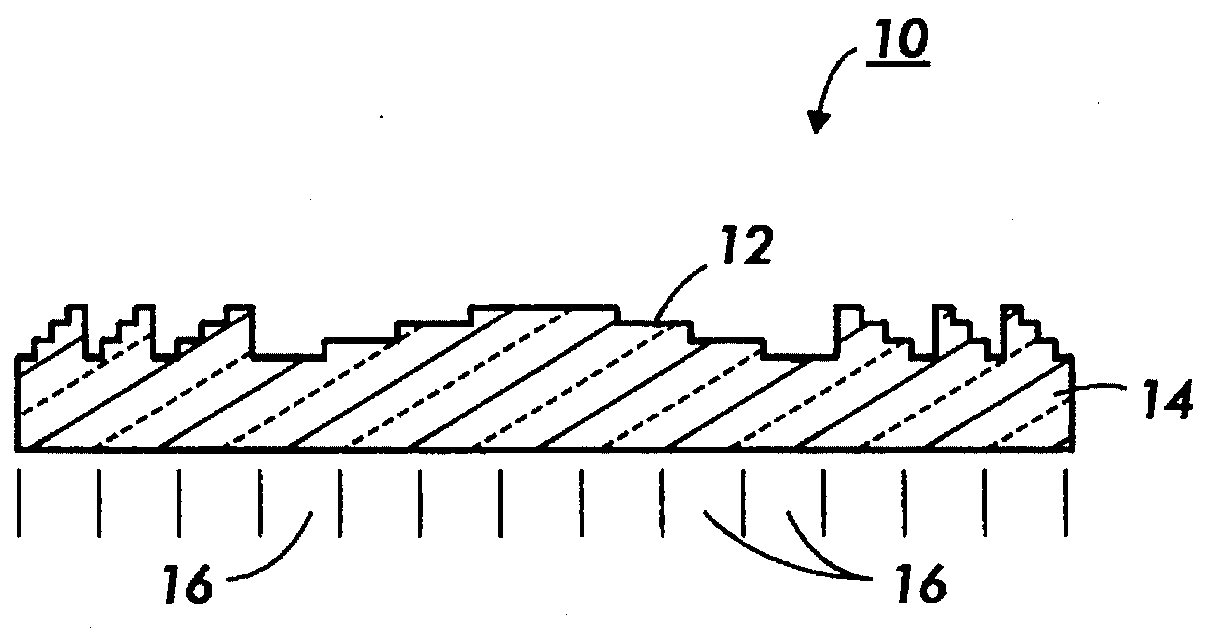
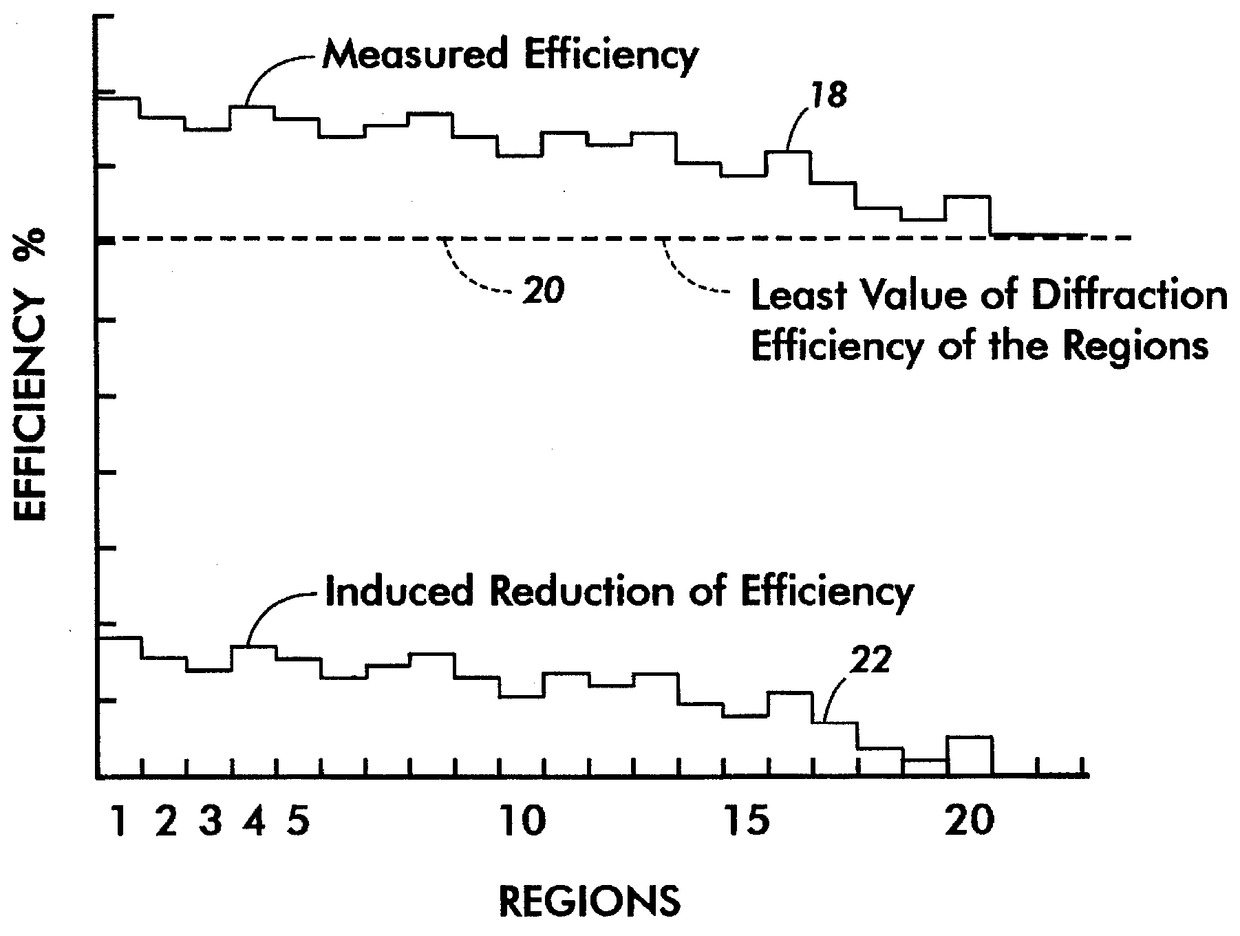
Try EurekaA first binary diffractive optical element has a multi-level surface relief phase grating structure on a substrate. The element is divided into regions commensurate with resolution requirements, and the diffraction efficiency of each region is measured. The lowest measured efficiency is taken as the reference value, and the efficiencies of all other regions are reduced region by region down to that common reference value.Filed by Xerox Corporation, granted 1996-03-05 — one of the earliest records in scope addressing region-by-region efficiency correction.
| # | Publication no. | Patent title | Citations |
|---|---|---|---|
| 1 | US9671566B2 | Planar waveguide apparatus with diffraction element(s) and system employing same | 989 |
| 2 | US20070188837A1 | Beam expanding optical element, beam expansion method, image display apparatus, and head-mounted display | 392 |
| 3 | US7061693B2 | Optical method and system for extended depth of focus | 283 |
| 4 | US5568574A | Modulator-based photonic chip-to-chip interconnections for dense three-dimensional multichip module integrati… | 260 |
| 5 | US20090185274A1 | Optical designs for zero order reduction | 253 |
| 6 | US20080043334A1 | Diffractive optical relay and method for manufacturing the same | 247 |
| 7 | US20100177388A1 | Diffractive optical relay device with improved color uniformity | 218 |
| 8 | US20170307886A1 | Refractive coating for diffractive optical elements | 193 |
| 9 | US20150309264A1 | Planar waveguide apparatus with diffraction element(s) and system employing same | 191 |
| 10 | US5986807A | Single binary optical element beam homogenizer | 167 |
Citation counts inside a searched corpus favour older filings and should be read as a signal of influence, not of current relevance.
Each row carries its publication number; clicking a row searches Eureka by that number.
When you want the answer in the next five minutes.
The agent works the prompt against patents and technical literature, citing every source.
Run your analysis now →When it has to run inside your own pipeline.
Patent search, landscape analysis and assignee resolution as MCP tools. Drop them into any agent framework, or call REST directly.
Browse MCP servers →Three patterns matter more than any single ranking: where claim density sits, how concentrated ownership is, and how the trend line is moving.
The top five filers together account for 44.9% of all 1,894 records, and the top ten for 53.8%. That leaves nearly half the field spread across a long tail of single- and few-filing entrants, which is where freedom-to-operate work tends to find open ground.
Annual filings peaked at 135 in 2020 and fell to 8 by the most recent, partial year, passing through a 2022 midpoint of 56. Remember the newest year is always undercounted because of publication lag, but the multi-year decline predates that effect.
Nearly every record in scope is classified under G02B, but secondary classes in lighting (F21V), imaging (H04N, G06T, G03B) and modulation (G02F) show where DOE claims are being extended into adjacent systems rather than staying purely optical.
Eureka can read the same corpus for gaps instead of for coverage: under-claimed branches adjacent to diffractive optical elements, with the prior art for and against each one.
The leader board is dominated by imaging, optics and AR/VR hardware companies, but recent-year momentum shows even the most active filers pulling back.
The top-ranked assignee holds 330 records, well ahead of the fifth-place filer at 39 and tenth place at 31 — a steep drop-off that marks a genuine leader rather than a crowded plateau.
The two assignees with the most filings in the latest year each show year-on-year declines above 60%, and several historically significant filers recorded zero filings in that same period. This is consistent with the broader decline visible in the trend chart, not an isolated slowdown.
Only eight co-assignee pairs appear in the dataset, and the strongest recurring pairings involve inventor-assignee combinations at a small number of large filers rather than cross-company joint filings.
| Assignee | Recent year | YoY |
|---|---|---|
| Magic Leap, Inc. | 3 | -63% |
| Snap Inc. | 2 | -67% |
| Canon Inc. | 0 | — |
| Nikon Corporation | 0 | — |
| WaveOptics Ltd. | 0 | — |
| Sumitomo Electric Industries, Ltd. | 0 | — |
| Raytheon Company | 0 | -100% |
| Meta Platforms Technologies, LLC | 0 | — |
The dataset points to a mature, concentrated field with a shrinking annual filing rate — the open questions now are about where the remaining claim space sits and how defensible it is.
Cross-reference the under-claimed sub-areas against the leading assignees' portfolios to see which branches they have deliberately avoided versus simply not yet reached.
Explore white space in EurekaTwo of the most active recent filers are already declining by more than 60% year-on-year; tracking who fills that gap next is more informative than tracking who currently leads.
Track assignee momentum in EurekaThe highest-citation records date from earlier in the period and anchor much of the surrounding claim language; any new filing should be checked against them directly rather than against the broader field average.
Run an FTO check in EurekaFiling in this field is concentrated: the top-ranked assignee alone holds 330 of the 1,894 records in scope, far ahead of the fifth-place filer at 39 and tenth place at 31. The top five filers combined account for 44.9% of all records, and the top ten for 53.8%, which leaves close to half the field held by a long tail of smaller filers. Assignees active in AR/VR hardware, cameras and imaging optics dominate the upper ranks, reflecting DOEs' use in structured-light projection and waveguide displays.
No — filings peaked at 135 in 2020 and have declined since, passing through 56 at the 2022 midpoint down to 8 in the most recent, partial year. Because publication typically lags filing by around 18 months, the very latest year is always undercounted, but the multi-year downward trend predates that effect. This pattern is more consistent with a field where core claim space filled early than one still in active growth.
Almost all records, 99.0% of the 1,894 in scope, carry the G02B optical-elements classification, confirming this is fundamentally an optics field. Secondary classes show where DOE claims extend into other systems: F21V for lighting components at 7.7%, G01B for dimensional measurement at 5.3%, H04N for pictorial communication at 5.3%, and smaller shares in image processing (G06T), photographic apparatus (G03B) and optical modulation (G02F). These shares add up to more than 100% because individual records often carry several IPC codes.
The clearest opportunities sit in sub-areas that appear only as secondary IPC classes rather than as the core classification, such as zero-order suppression gratings, wavelength-tolerant multi-level phase structures, and fabrication-tolerance compensation layers. These branches carry comparatively thin claim density relative to the dominant G02B optics classification, and the near-half of records held outside the top ten filers suggests room for focused entrants. Confirming true white space still requires checking specific claim language against the leading assignees' existing portfolios.
The most-cited record in scope is US9671566B2, covering a planar waveguide apparatus with diffraction elements, cited 989 times, followed by US20070188837A1 on beam-expanding optics for head-mounted displays at 392 citations. Older records such as US7061693B2 on extended depth of focus and US20090185274A1 on zero-order reduction also carry high citation counts. Because citation counts inside a searched corpus favour older filings, these figures signal historical influence on surrounding claim language rather than current commercial importance.
Go past this page: query the whole diffractive optical elements corpus yourself, in your own scope.
Every answer comes back with patent numbers you can open.
Disclaimer. This page is generated from Patsnap Eureka data drawn from a limited snapshot of global patent and scientific-literature records, and is provided for general information and reference only.
Patent data carries inherent limitations: recent filings (typically the most recent 18–24 months) are under-counted due to standard publication lag; counts may be reported at either a patent-family or a patent-record basis and are not always directly comparable; classification, applicant-name, and citation data may contain errors, duplicates, or omissions; and the underlying search query defines and constrains the scope shown. As a result, the analysis may be incomplete or inaccurate and may not reflect the full technology landscape.
Nothing on this page constitutes an exhaustive prior-art, novelty, freedom-to-operate, or validity search, nor does it constitute legal, financial, investment, or professional advice, and it should not be relied upon as such. Any patent, commercial, or strategic decision should be verified independently and reviewed with qualified patent, legal, and domain professionals. Patsnap makes no warranties, express or implied, as to the accuracy, completeness, or fitness for any particular purpose of the information presented.
Machine translation. Assignee and organisation names originally recorded in Chinese, Japanese or Korean have been rendered into English by an AI translation step so that the tables stay readable. These renderings are best-effort and may not match a company's registered English name; the original name is what the underlying patent record carries, and it is what any Eureka query launched from this page uses.
Help us improve
Something wrong, out of date, or missing on this page? Tell us and it goes straight to the team that maintains it.
This page