Fastest
Eureka on the web
When you want the answer in the next five minutes.
The agent works the prompt against patents and technical literature, citing every source.
Run your analysis now →Filing growth compares 2021 (88 records) with 2024 (128) — a three-year span. 2024 is the most recent year we treat as complete: publication lags filing by roughly 18 months, so 2025 onwards are still filling in and any growth rate that ends there would understate the field. Top-5 share is the combined record count of the five largest assignees divided by all 1,071 records in scope (CR5), not by the ranked leaders only.
Sulfide solid electrolytes promise higher ionic conductivity than oxide or polymer alternatives, but they bring a processing problem: exposure to moisture generates hydrogen sulfide, and manufacturing has to happen in dry rooms with tight interfacial control between electrolyte and electrode. This landscape tracks patent filings at the intersection of sulfide and argyrodite electrolyte chemistry with the processing techniques that make them manufacturable — cold pressing, interfacial coating, and hydrogen sulfide suppression — filtered to the core battery and inorganic-compound IPC classes.
The dataset spans 1,071 patent families filed between 2015 and mid-2026, with publication naturally lagging filing by around 18 months, so the most recent year understates real activity. Records concentrate overwhelmingly in H01M (batteries and cells), with meaningful secondary weight in C01B inorganic compounds and H01B conductor materials, pointing to a field still organised around core battery chemistry rather than spun out into adjacent material classes.
Pick a task. Every answer cites the patents behind it.
Annual filing counts and IPC distribution for the 1,071 families in this dataset, drawn from records published between 2015 and the July 2026 cut-off.
Filings rose from 32 in 2017 to a peak of 160 in 2025, passing through a 2022 midpoint of 118. The partial 2026 figure of 29 sits well below the 2025 peak, consistent with publication lag rather than a genuine slowdown in filing intent — but the flattening trend from 2022 onward suggests the field is maturing past its steepest growth phase.
H01M dominates with 1,057 of 1,071 records touching core battery and cell classifications. C01B (inorganic compounds, 274) and H01B (conductors and insulators, 259) form a secondary tier tied to electrolyte material synthesis and ionic transport, while glass compositions (C03C, 51) and ceramics (C04B, 19) remain comparatively thin — a signal of where material-science crossover claims are still sparse.
Shares are the percentage of the 1,071 records in scope. A patent can carry several IPC classes, so the shares add up to more than 100%.
This page is one run against one query. Ask Eureka your own question about solid-state sulfide electrolyte processing and every answer comes back with the patent numbers behind it.
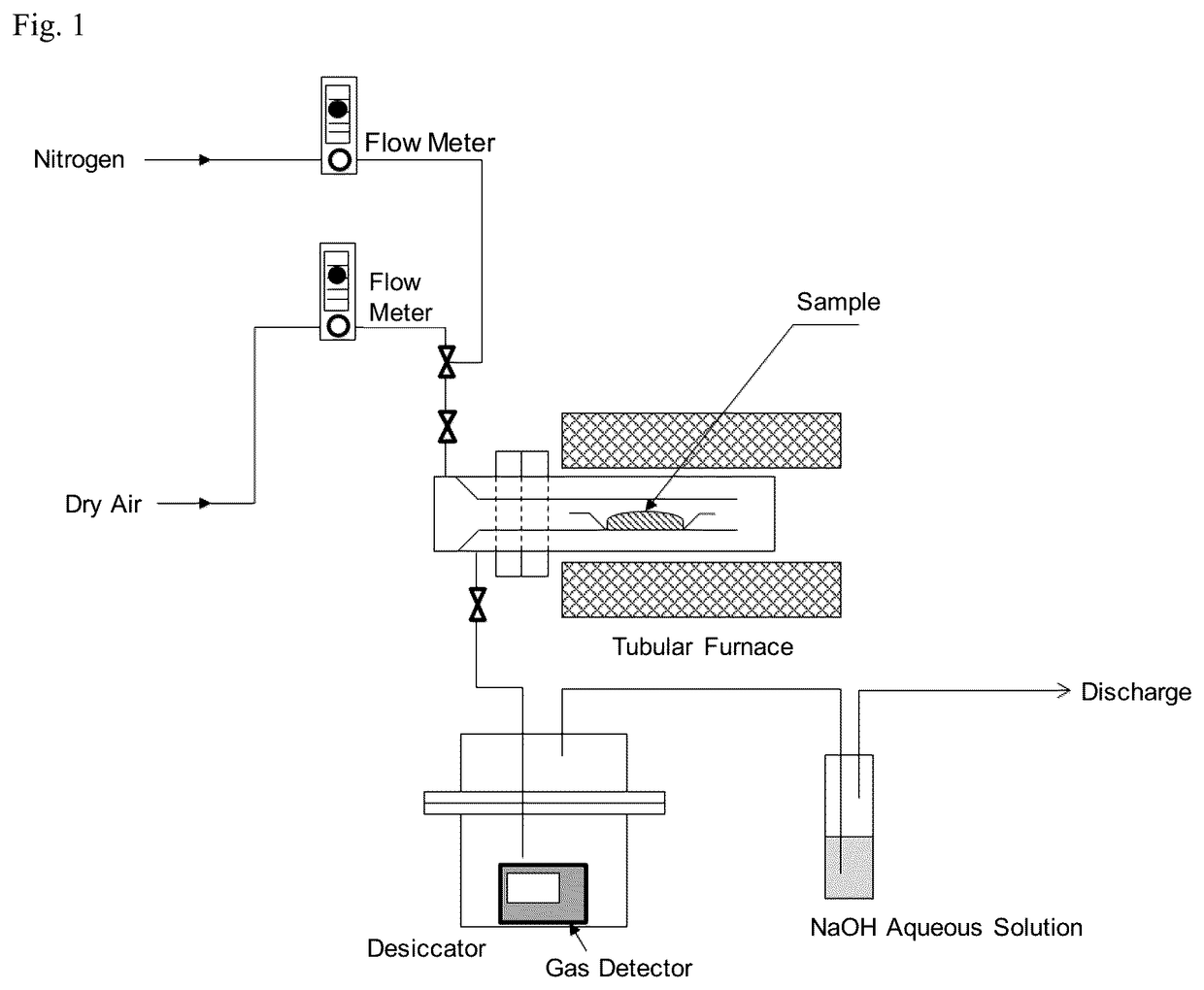
Try EurekaProvided are a sulfide solid electrolyte composition containing a sulfide solid electrolyte and red phosphorus, having an excellent flame retardancy and a high ionic conductivity and further having excellent hydrogen sulfide generation suppressing performance; an electrode mixture containing the composition; and a method for producing a sulfide solid electrolyte composition including mixing a sulfide solid electrolyte and red phosphorus.Filed by Idemitsu Kosan, published 2024-08-22 — illustrates how additive chemistry (red phosphorus) is being claimed alongside the core sulfide electrolyte to address the field's central safety problem.
| # | Publication no. | Patent title | Citations |
|---|---|---|---|
| 1 | JP2013033659A | Solid electrolyte material-containing body and battery | 93 |
| 2 | US20130164631A1 | Sulfide solid electrolyte material and lithium solid state battery | 83 |
| 3 | US20120301796A1 | Method of producing a sulfide solid electrolyte material, sulfide solid electrolyte material, and lithium bat… | 82 |
| 4 | JP2010199033A | Sulfide solid electrolyte material | 75 |
| 5 | US20160204467A1 | Solid-state battery | 56 |
| 6 | CN108493479A | 一种基于氧掺杂的硫化物固体电解质及其制备方法 | 51 |
| 7 | US20150093652A1 | Sulfide solid electrolyte, method of preparing the same, and solid state battery including the same | 51 |
| 8 | WO2012026238A1 | Sulfide solid electrolyte material and lithium solid state battery | 48 |
| 9 | US20120034529A1 | Sulfide solid electrolyte material | 47 |
| 10 | US20120189918A1 | Sulfide solid electrolyte | 44 |
Citation counts favour older filings simply because they have had more time to accumulate citations within the searched corpus; treat them as a signal of influence on the field's foundational chemistry, not of current commercial weight.
Patent titles are shown in the language they were filed in, not translated, so that each record stays verifiable against the original filing — a translated title will not match in Eureka or in any national register. Each row carries its publication number; clicking a row searches Eureka by that number.
When you want the answer in the next five minutes.
The agent works the prompt against patents and technical literature, citing every source.
Run your analysis now →When it has to run inside your own pipeline.
Patent search, landscape analysis and assignee resolution as MCP tools. Drop them into any agent framework, or call REST directly.
Browse MCP servers →Three patterns stand out once the filing trend, IPC spread and receiving-office data are read together.
Filings climbed from 32 in 2017 to a 2022 midpoint of 118 and a peak of 160 in 2025. That trajectory is a maturing S-curve, not a technology still in its early exponential phase — new entrants now compete against a decade of accumulated prior art rather than an open field.
China's 398 filings sit ahead of the United States (305) and the EPO (191), with Japan (48), WIPO (33) and India (24) trailing well behind. Freedom-to-operate work that only checks US and European registers will miss the largest single pool of claims in this field.
Only 10 co-assignee pairs appear across the entire dataset, and the strongest — a materials supplier paired with a technology partner — reaches just 12 shared families. Joint ventures and cross-licensing deals remain the exception rather than the rule in this corpus.
The near-total concentration in H01M, with C01B and H01B as the only substantial secondary classes, indicates that most applicants are claiming electrolyte-in-cell configurations rather than upstream synthesis or bulk material production — a gap that shows up again in the white-space analysis.
Eureka can read the same corpus for gaps instead of for coverage: under-claimed branches adjacent to solid-state sulfide electrolyte processing, with the prior art for and against each one.
Recent-year momentum figures show a field where even the most active assignees are filing in single digits per year, and several established names have gone quiet.
Idemitsu Kosan's latest-year filing count held flat year-on-year, consistent with its representative filing in this dataset on hydrogen sulfide suppression chemistry — a sign of continued, if modest, investment in additive-based safety claims.
Toyota and Samsung SDI both show a 100% year-on-year drop to zero latest-year filings. Given publication lag, this may reflect filings still in the pipeline rather than an actual pullback, but it is worth watching for confirmation in the next data refresh.
The strongest co-assignee relationship in the dataset links a specialty chemicals supplier with a technology partner across 12 shared families, ahead of a Toyota-Panasonic pairing and a Samsung SDI-university pairing, both at 8. These pairs suggest joint IP is concentrated around materials-to-cell integration work.
| Assignee | Recent year | YoY |
|---|---|---|
| Idemitsu Kosan Co., Ltd. | 1 | 0% |
| Mitsubishi Gas Chemical Company, Inc. | 1 | -50% |
| Panasonic Intellectual Property Management Co., Ltd. | 1 | 0% |
| Toyota Motor Corporation | 0 | -100% |
| Mitsui Mining & Smelting Co., Ltd. | 0 | — |
| Samsung SDI Co., Ltd. | 0 | -100% |
| GS Yuasa International Ltd. | 0 | -100% |
| Tokyo Institute of Technology | 0 | -100% |
The filing and IPC data point to specific next steps depending on whether the goal is freedom-to-operate, licensing, or R&D prioritisation.
With 398 receiving-office filings, China holds more claims in this space than the US and EPO combined. Any freedom-to-operate review that starts with Western registers will be working from an incomplete picture.
Run a China-focused search in EurekaToyota and Samsung SDI both show a drop to zero latest-year filings. Confirming whether this is a genuine pullback or a publication-lag artefact matters for anyone assessing competitive pressure in this field.
Track assignee momentum in EurekaRed phosphorus additive chemistry and interfacial coating layers sit in thinner IPC territory than core cell configuration claims. This is where a well-drafted first claim has more room to stand apart from prior art.
Explore white space in EurekaA sulfide solid electrolyte is a solid-state lithium-ion conductor built from sulfide compounds, such as argyrodite or LGPS-type materials, valued for high ionic conductivity compared with oxide or polymer alternatives. The processing challenge is that these materials react with moisture to generate hydrogen sulfide gas, which is toxic and corrosive, so manufacturing must happen in controlled dry rooms with careful handling. Because that manufacturing constraint is as commercially important as the chemistry itself, a large share of patent claims in this dataset target processing techniques — cold pressing, interfacial coating and hydrogen sulfide suppression — rather than the base electrolyte composition alone.
China leads with 398 receiving-office filings in this dataset, ahead of the United States at 305 and the European Patent Office at 191. Japan, the WIPO PCT route, and India follow well behind at 48, 33 and 24 respectively. This distribution means a freedom-to-operate review limited to US and European filings would miss the single largest pool of claims, and it reflects China's build-out of domestic battery material manufacturing capacity.
Filings grew substantially from 32 in 2017 to a peak of 160 in 2025, but the trajectory has flattened since the 2022 midpoint of 118 rather than continuing to accelerate. The partial 2026 count of 29 looks like a steep drop, but that is expected: patent publication typically lags filing by around 18 months, so recent-year figures are always understated until later data refreshes catch up. Read together, the pattern looks like a maturing field rather than one still in early exponential growth.
The dataset shows momentum data for assignees including Idemitsu Kosan, Mitsubishi Gas Chemical, Panasonic Intellectual Property Management, Toyota, Mitsui Mining & Smelting, and Samsung SDI, though several of the more established names show sharp year-on-year declines in latest-year filings. Co-assignee filing is uncommon overall, with only 10 recorded pairs, the strongest linking a specialty chemicals supplier and a technology partner across 12 shared families. This suggests the field has a handful of consistently active filers alongside a longer tail of single-filing entrants rather than a small tightly-networked group.
IPC composition data shows claims concentrated heavily in H01M battery classifications, with secondary weight in C01B inorganic compounds and H01B conductors, but comparatively thin coverage in glass compositions (C03C), ceramics (C04B) and alkaline-earth or rare-earth compounds (C01F). That thinner coverage points to under-claimed territory around glass-ceramic sintering routes, ceramic-matrix cold-pressing binders, and rare-earth dopant stabilisation — areas adjacent to the core chemistry but not yet heavily staked out by existing claims.
Go past this page: query the whole solid-state sulfide electrolyte processing corpus yourself, in your own scope.
Every answer comes back with patent numbers you can open.
Disclaimer. This page is generated from Patsnap Eureka data drawn from a limited snapshot of global patent and scientific-literature records, and is provided for general information and reference only.
Patent data carries inherent limitations: recent filings (typically the most recent 18–24 months) are under-counted due to standard publication lag; counts may be reported at either a patent-family or a patent-record basis and are not always directly comparable; classification, applicant-name, and citation data may contain errors, duplicates, or omissions; and the underlying search query defines and constrains the scope shown. As a result, the analysis may be incomplete or inaccurate and may not reflect the full technology landscape.
Nothing on this page constitutes an exhaustive prior-art, novelty, freedom-to-operate, or validity search, nor does it constitute legal, financial, investment, or professional advice, and it should not be relied upon as such. Any patent, commercial, or strategic decision should be verified independently and reviewed with qualified patent, legal, and domain professionals. Patsnap makes no warranties, express or implied, as to the accuracy, completeness, or fitness for any particular purpose of the information presented.
Machine translation. Assignee and organisation names originally recorded in Chinese, Japanese or Korean have been rendered into English by an AI translation step so that the tables stay readable. These renderings are best-effort and may not match a company's registered English name; the original name is what the underlying patent record carries, and it is what any Eureka query launched from this page uses.
Help us improve
Something wrong, out of date, or missing on this page? Tell us and it goes straight to the team that maintains it.
This page