




Better Patent Drafting Through Augmented Intelligence
How human expertise and AI can work together to produce better patent drafts
By Matthew Birch, Chartered and European Patent Attorney, Patsnap
Key takeaways
- One trial suggests AI assistance can improve drafting quality. In a preregistered, three-month randomised trial of 133 practising patent lawyers at eleven US intellectual property law firms (Autor et al., NBER Working Paper 35720, 2026), AI assistance raised expert-rated drafting quality by 0.34 standard deviations at ten days and 0.38 at ninety days. It is a single Google-funded working paper on a custom assistant, so we read it as a reason to explore the question, not a settled answer.
- In that trial, the gains looked broad and mostly lifted the weakest drafts. In the Autor trial, quality improved across all five assessed dimensions (enforceability, accuracy, strategic ambiguity, completeness and clarity), mainly through fewer poor scores.
- A possible carry-over for senior lawyers, but not for juniors. When participants later redlined an application without AI, surprisingly, senior lawyers who had used the AI assistant did better than those who hadn’t, while junior lawyers showed no average gain.
- GUARD is our proposed framework for AI drafting, partly motivated by the trial. GUARD (Ground, Uncover, Attack, Refine, Demonstrate) pairs each AI contribution with an attorney decision, with transparency and traceability at every step.
“The better we get at getting better, the faster we will get better.”
— Douglas Engelbart [4]
I’m often asked how quickly our AI drafting tool can turn an invention disclosure into a first draft, and how much attorney time it might save. It’s a fair question. Drafting takes sustained attention and clients quite reasonably expect value for money.
What interests me more, though, is what the attorney and AI might achieve together once we look beyond the first draft. Could the tool prompt a question about the invention that would otherwise go unasked, or help the attorney spot a weakness in a claim they were happy with?
Recent research gives us reason to think that AI assistance can improve drafting quality and raises some interesting questions about what attorneys themselves learn along the way. For me, that is where augmentation becomes more interesting than automation. The opportunity is to help the attorney do better work, with enough visibility and transparency of AI suggestions to question them and steer the process with confidence and trust. Getting that relationship right takes some thought about how we work with the tools and that’s what I want to explore here.
That question of how we work with our tools takes us back to Douglas Engelbart, who was exploring augmentation long before modern AI. In his 1962 framework, he looked at a person’s capabilities in the context of the tools they used and the way they worked. Language mattered too, as did the training needed to bring everything together. He called this system H-LAM/T. The idea is that improving the tool and how we use it together can put previously unmanageable problems within reach. [1]
Patent drafting fits that picture nicely. A drafting attorney needs to understand an invention, decide where the focus should lie, and unite technical detail with legal completeness in one coherent strategy. Modern AI drafting tools can contribute at many points throughout the drafting process, while the attorney judges their suggestions against the invention disclosure, the prior art and the client’s own aims and wider commercial context.
Here we look at how the best available evidence might inform that partnership and suggest a framework to help an AI/attorney team reach its full potential.
What one trial suggests
In a three-month field trial reported by Autor and colleagues (NBER, 2026), AI assistance made patent drafts measurably better as judged by blinded experts. They ran a preregistered randomised trial with 133 practising patent lawyers at eleven US intellectual property law firms, randomly assigning access to a custom AI drafting assistant. The study assessed expert-rated drafts rather than grant rates or litigation outcomes. The study was Google-funded and was published as an NBER working paper. [2]
In the Autor trial, quality on benchmark drafting tasks rose by 0.34 standard deviations at ten days and 0.38 at ninety days, with larger gains among junior lawyers. [2]
The improvement appeared across all five assessed dimensions. These were enforceability, accuracy, strategic ambiguity, completeness and clarity. [2] As one might expect, most of the gain came from fewer poor scores, which means the tool mainly lifted the weakest drafts or raised the floor. [3] That alone is an improvement worth having, but not the whole story.
| Study | Autor et al. (2026), Does AI Assistance Enhance or Erode Expertise? NBER Working Paper 35720 [2] |
| Design | Preregistered randomised field trial over three months |
| Participants | 133 practising patent lawyers at eleven US intellectual property law firms |
| Intervention | Random assignment of access to a custom AI drafting assistant |
| What was measured | Draft quality as rated by blinded experts, not grant rates or litigation outcomes |
| Quality dimensions | Enforceability, accuracy, strategic ambiguity, completeness and clarity |
| Reported results | +0.34 standard deviations at ten days and +0.38 at ninety days, with larger gains among junior lawyers |
| Finding and status | Google-funded; NBER working paper (September 2026, revised October) |
| Limits | One study of one custom assistant at US firms, so results may not transfer to other tools, jurisdictions or settings; the explanations for the junior and senior results are untested hypotheses |
The trial produced a more surprising result. After three months, participants redlined an existing application without access to AI. Some of them had been using AI for those three months and some hadn’t. Those who had been given AI access previously did better overall, with the advantage concentrated among senior lawyers, while junior lawyers showed no average gain and their outcomes grew more dispersed. [2]
Autor and Rodchenko offer a plausible explanation for the senior lawyers. The ones in the AI group concentrated on substantive claim changes and potentially restrictive wording, and interviewees described the tool as a “logic auditor” that loosened their attachment to existing prose and made them articulate why a structure should change. [3] For junior lawyers, I think it is possible that some had improved through exposure to AI, as the senior lawyers had, while others may have become over-reliant. These hypotheses have not yet been tested.
From a trial to a proposal: Patsnap’s GUARD framework for AI-assisted patent drafting
Patsnap’s GUARD framework (Ground, Uncover, Attack, Refine, Demonstrate) offers a practical method motivated by the Autor study and the idea of augmentation. It is our proposal for how an attorney and AI might work together and has not been tested in a trial. Transparency and traceability underpin every step, with the attorney involved throughout. The attorney needs to see the disclosure basis for a proposed feature and be able to question AI suggestions before they shape the application. Each step pairs an AI contribution with a decision for the attorney, keeping that decision connected to the evidence.
The trial suggests that AI can improve drafts, and it hints that how lawyers engage with the tool matters as much as having it in the first place. An AI assistant dropped into an unchanged process leaves most of the opportunity for augmentation unexplored.
Customisable drafting templates can be built from scratch or based on existing applications or patent publications. They provide the preferred document structure and layout.
The attorney can shape how the two work together through a reusable set of AI Instructions, which can be saved and applied to any project. These set out drafting preferences and style, together with how the AI should interact with the attorney. An attorney might want the AI to pause before proceeding with a claim strategy, for example, or ask for alternatives when the disclosure leaves scope for different approaches. The attorney can therefore carry a preferred way of working across projects, alongside whichever drafting template is appropriate.
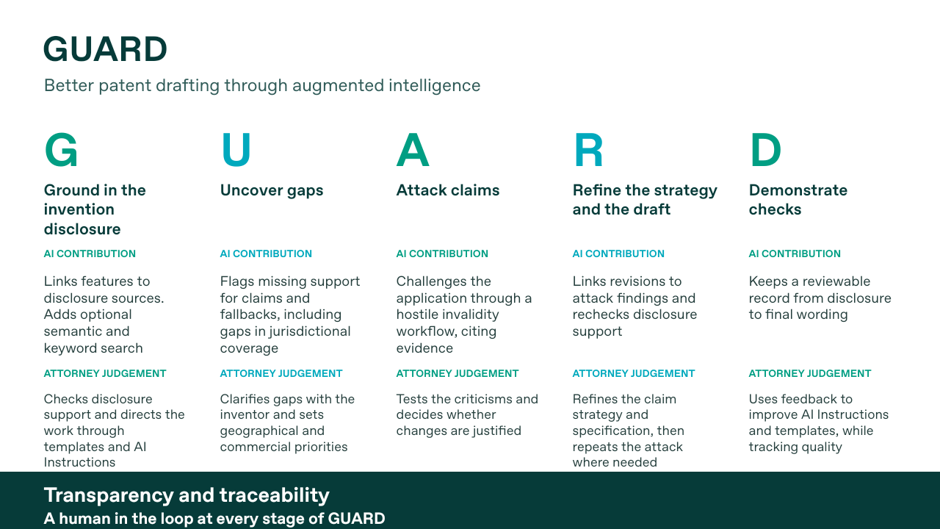
GUARD at a glance: how we imagine attorney and AI working together
- Ground in the invention disclosure: AI should link proposed features to disclosure sources.The attorney checks the support and directs the work through templates and AI Instructions.
- Uncover gaps: AI should flag missing support for claims and fallbacks, including gaps in jurisdictional coverage. The attorney clarifies gaps with the inventor and sets geographical and commercial priorities.
- Attack claims: AI should challenge the application through a hostile invalidity workflow, citing evidence. The attorney tests the criticisms and decides whether changes are justified.
- Refine the strategy and the draft: AI should link revisions to attack findings and recheck disclosure support. The attorney refines the claim strategy and specification, then repeats the attack where needed.
- Demonstrate checks: AI should keep a reviewable record from disclosure to final wording. The attorney uses that feedback to improve AI Instructions and templates while tracking quality.
G: Ground in the invention disclosure
In Patsnap’s GUARD framework, grounding begins with the invention disclosure. Proposed claim features and technical statements should be traceable to the relevant source passages, drawings or data to help address concerns about AI inventorship. The attorney needs to see what each proposal rests on and confirm that the source supports the wording. Where the basis is missing or uncertain, the tool should expose that uncertainty and invite clarification, rather than invent or fabricate details.
Engelbart imagined linked information structures through which a person could inspect the premises behind a conclusion. [1] Applied to drafting, this means making the path from disclosure to draft visible. The attorney can check the AI’s interpretation against the source and decide whether the wording needs to change. That involvement continues as the draft develops, so changes in claim scope remain connected to their factual basis.
Disclosure grounding remains the foundation, with a built-in prior art search providing an additional source of insight. Patsnap’s drafting tool itself includes an optional semantic and keyword search, with a dedicated searching platform also available for a fully augmented search combining different search types and iterative refinement of the search by the LLM. The attorney guides the search strategy and assesses the findings against the proposed claims. The relevant passages need to be readily inspectable so the attorney can challenge a result or change the search direction. Prior art findings remain clearly distinguished from the inventor’s disclosure, so they inform the strategy without obscuring the factual basis for the draft.
U: Uncover gaps
A gap in the disclosure is easy to miss once the draft begins to read smoothly. In GUARD, the tool should flag where it identifies potential gaps in support for useful claims and fallback positions to help provide resilience and adaptability throughout prosecution and in case of any post-grant attack or enforcement. If the attorney agrees, they may need to go back to the inventor before filing and the draft may need adjusting to take into account new information. Keeping a record of how any concerns were resolved maintains transparency and traceability for a reviewer and builds trust and shared logic between the user and the tool.
Gaps may also relate to broader considerations like claim types and jurisdictional nuances. Different patent offices have their own requirements on claim formats, which the drafting workflow needs to take into account. The attorney can bring context on likely geographical spread and commercial focus, and the tool can then help check whether the draft accommodates the intended jurisdictions, highlighting where there may have been an oversight or inconsistency in the strategy or language. In this way, the attorney can work with the AI to reduce the risk of overlooking an important provision.
R: Refine the strategy and the draft
In GUARD, the attack phase gives the attorney a reason to look again at the claim strategy. The tool should connect each proposed revision to the weakness it addresses and show its basis in the disclosure. A persuasive criticism may call for a different independent claim. In other cases, the main claim may stand but the dependent claims or accompanying description need more work. The attorney can consider the available options before deciding what best serves the client’s commercial aims within what the disclosure and prior art allow.
The specification must support whichever strategy emerges from that review. The attorney may need more technical detail from the inventor, particularly where a useful fallback has not been fully described. As the wording changes, its links to supporting material need checking again. Any uncertainty should be brought back to the attorney. Terminology and consistency checks remain part of the work but refinement can change the substance of the application. If the proposed protection changes materially, it makes sense to run it through the attack phase again.
Time saved on first drafts as a by-product of using AI gives the attorney more room for this work. The record should explain the decisions made so that a reviewer can understand why the draft changed. What matters is whether the review has resolved uncertainties and left the attorney with claims and fallback positions they can justify upon challenge.
D: Demonstrate checks
In GUARD, the checks need to leave a record that someone else can follow. A reviewer should be able to trace a feature from the disclosure through to the final wording. If a search finding or attack prompted a revision, the record should explain the attorney’s response. It should also be clear why a suggestion was set aside. The attorney needs access to this history as the work develops, so they can step in and redirect it when necessary.
Reviewers often find themselves correcting the same things. Recording those corrections gives a team something concrete to work on when improving the tool and its training. If unsupported generalisations keep recurring, for example, the tool should ask for clarification sooner.
The same feedback can help the attorney refine their reusable AI Instructions. If the AI asks for input too late, the attorney can change the check-in point for future projects. Wording that they routinely amend can also be addressed through the instructions, while a change in the preferred document structure belongs in the template.
The same feedback can help the attorney refine their reusable AI Instructions. If the AI asks for input too late, the attorney can change the check-in point for future projects. Wording that they routinely amend can also be addressed through the instructions, while a change in the preferred document structure belongs in the template.
Judging success: what better AI-assisted patent drafting might look like
Speed will remain part of the case for AI in patent drafting. We think the greater opportunity is to help attorneys produce better applications more consistently. GUARD gives findings from a search or an attack a route back into the drafting strategy, where the attorney can act on them. Its value should show in the application itself. The claim strategy needs to reflect the evidence, with weaknesses properly examined before filing. The disclosure must also support the protection the client is seeking.
That brings us back to Engelbart’s idea of augmentation. Automating parts of drafting can release time, but the professional benefit depends on what the attorney can do with that time and with the tool’s assistance. They might pursue a technical question that would otherwise receive less attention. They can also compare an unfamiliar claim formulation with their first choice or subject a favoured claim to a hostile reading before committing to it. AI makes room for a wider examination, while the attorney directs the work and decides what stands up to scrutiny.
For that to work, the attorney needs to be able to see the basis for the AI’s suggestions and question them throughout. A polished draft has limited value if its author cannot explain why the claims take that form. What I want to see is an application whose strategy has been challenged and whose choices the attorney can justify, with a record that is easy to inspect. That record also gives us a way to review how the work was done and improve the process for the next application. I find the opportunity for compounding improvement very exciting.
The Autor findings give us reason to pursue this approach, although there is still much to establish about longer-term outcomes. Firms adopting these tools now have an opportunity to develop working methods and training that make better assisted performance part of everyday practice. For me, that is the ambition of augmented intelligence. The attorney can examine possibilities they might otherwise miss and test their preferred approach more thoroughly, bringing better-informed judgement to the protection the client needs.
About the author
Matthew Birch is AI Solutions Lead, IP at Patsnap, where he leads the roadmap for its agentic patent drafting products. A Chartered and European Patent Attorney with more than 15 years in patent prosecution and litigation at leading European IP firms and a global law firm, he has specialised in engineering and technology, including medical devices and renewable energy.
References
[1] Engelbart, D. C. (1962). Augmenting Human Intellect: A Conceptual Framework. SRI Summary Report AFOSR-3223. https://dougengelbart.org/pubs/augment-3906.html
[2] Autor, D., Rodchenko, T., Martin, J., Iscenko, Z., Strand, S., Pearl, D. and Ferere, M. (2026). Does AI Assistance Enhance or Erode Expertise? Evidence from a Three-Month Field Experiment in Patent Drafting. NBER Working Paper 35720, September, revised October. https://doi.org/10.3386/w35720
[3] Autor, D. and Rodchenko, T. (2026). Does better work always mean better workers? Google Research, 7 October. https://research.google/blog/does-better-work-always-mean-better-workers/
[4] Computer History Museum. Douglas C. Engelbart, Fellow profile. https://computerhistory.org/profile/doug-engelbart/
What we don’t know yet
The trial measured expert ratings of drafts, not grant rates, litigation outcomes or client results, and it tested one custom assistant with US firms. We do not yet know whether the findings carry over to other tools, jurisdictions or attorneys, or whether the effects last beyond the three months studied. Why junior lawyers’ outcomes diverged is untested, and so is whether a structured approach such as GUARD adds anything beyond giving attorneys access to AI. We offer GUARD as a hypothesis worth testing and would welcome evidence that confirms or challenges it.
Questions worth asking
What does the evidence so far suggest about AI and patent draft quality?
One trial suggests it can, though it is a single working paper on a custom assistant. In a preregistered randomised trial of 133 practising patent lawyers at eleven US intellectual property law firms (Autor et al., NBER Working Paper 35720, 2026), AI assistance raised expert-rated drafting quality by 0.34 standard deviations at ten days and 0.38 at ninety days, with gains across enforceability, accuracy, strategic ambiguity, completeness and clarity. The study measured expert-rated drafts rather than grant rates or litigation outcomes.
What might AI use mean for attorneys’ own drafting skills?
The early, limited evidence differs by seniority. When trial participants later redlined an application without AI, senior lawyers who had used AI did better on that single task than those who hadn’t, while junior lawyers showed no average gain and their outcomes grew more dispersed. Why junior lawyers’ outcomes diverged has not yet been tested.
What might attorneys check when reviewing an AI-generated patent draft?
Patsnap’s GUARD framework, which is a proposal rather than a tested method, suggests five checks: that proposed features are grounded in the invention disclosure; that gaps in support, fallback positions and jurisdictional coverage are uncovered; that the claims are tested against a hostile invalidity attack; that the strategy and draft are refined in response; and that each decision is recorded so a reviewer can follow it.
What is the GUARD framework?
GUARD (Ground, Uncover, Attack, Refine, Demonstrate) is Patsnap’s proposed method for AI-assisted patent drafting; it has not yet been tested in a trial. Each step pairs an AI contribution with a decision for the attorney, and transparency and traceability underpin every step, with the attorney involved throughout.
