


Why Engineers and R&D Teams Need Smarter Innovation Tools Now
Currently Playing Post:Why Engineers and R&D Teams Need Smarter Innovation Tools Now
Engineering and R&D organizations are at a pivotal moment. A new global study by Capgemini shows an unmistakable trend:
Innovation is getting harder, more expensive, and more time-pressured.
At the same time, AI is reshaping how new products, materials, drugs, and technologies are discovered.
Leaders across industries agree on one thing: the next few years will determine who innovates and who falls behind.
In this environment, innovation intelligence platforms like Patsnap are no longer optional. They’re becoming foundational.
The Pressure is Real: R&D is Getting Slower and More Costly
The report reveals sobering metrics:
- 78% of engineering and R&D leaders say their costs have increased over the past three years.
- Nearly half report that design and development cycles are getting longer—not shorter.
- 44% believe their organisation could lose significant market share in the next five years if they don’t speed up innovation.
- Cost pressures are intensifying: leaders now target ~10% cost reductions and nearly 10% faster development cycles—all within the next 2–3 years.
This widening gap between expectations and reality is exposing a fundamental truth:
The old way of doing R&D doesn’t scale in a world where competition, complexity, and speed are all accelerating.
AI Is the Turning Point But Most Organizations Aren’t Ready
AI sits at the center of the transformation where over 75% of engineering leaders expect AI to deliver 20–50% improvements in productivity, time-to-market, concept development, and cost reduction.
Tools like digital twins, generative AI, and next-gen materials modelling are seen as the top three transformative technologies.
Yet, most organizations say their AI maturity is still low. Many are still in pilot phases. And reliability, data integration, and governance remain major hurdles.
This is where Patsnap can help.
Why Patsnap is Essential for Engineers and R&D Teams Today
1. Turn Cost and Time Pressures Into Competitive Advantage
R&D teams need to work smarter, not just harder. Patsnap helps engineers:
- Reduce the time spent on manual research, benchmarking, and IP checks
- Identify emerging technologies much earlier
- Shorten concept-to-prototype cycles with faster insight generation
- Avoid costly dead ends with validated, structured data
When every R&D decision can carry multi-million-dollar downstream impact, teams need clean, connected, decision-ready data and not scattered PDFs and fragmented searches.
2. Bridge the “AI Readiness Gap” in Engineering and Science
Many organizations see the potential of AI, but few have the foundation needed to deploy it effectively.
Patsnap provides:
- High-quality, structured global data across patents, scientific literature, regulatory filings, clinical trials, materials data, and more
- AI models trained on engineering and scientific domains not generic text models
- Agentic AI capabilities that automate research, summarise findings, validate results, and integrate directly with internal workflows
This gives engineering teams the accuracy, reliability, and explainability they need for scientific decision-making, something general-purpose AI alone cannot provide.
3. Accelerate Life Sciences, Deep Tech & Materials Innovation
As stated in the global study report, clinical development timelines have lengthened significantly over the past decade.
Next-generation materials are among the top drivers of R&D transformation while documentation, compliance, and IP complexity continue to increase.
Patsnap is uniquely positioned across these innovation-intensive verticals:
- Life sciences: Faster target ID, repurposing insights, trial landscape mapping, competitive intelligence
- Materials science: Access to materials properties, formulations, performance data, and simulations
- Deep tech & manufacturing: Benchmarking, technology landscaping, design inspiration, and validation
When industries grow more complex each year, Patsnap acts as the connective tissue between data, science, and strategy.
4. Strengthen IP Strategy in a High-Velocity Innovation Cycle
With AI accelerating invention, IP teams face:
- More filings
- Faster competitive shifts
- Higher compliance burdens
- More complex global landscapes
Documentation and compliance are among the top areas where AI will have near-term impact.
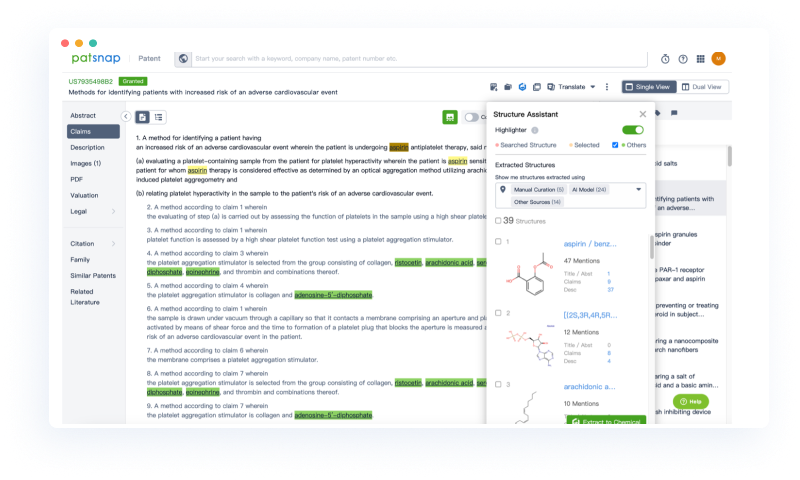
Patsnap enables R&D and IP teams to:
- Monitor global filings in real time
- Validate novelty and freedom-to-operate early
- Prevent duplication and wasted R&D spend
- Ensure alignment between innovation, patenting, and commercial goals
In a world where innovation speed defines survival, IP intelligence becomes a front-line strategic tool.
5. Build the Human-AI Hybrid Workforce of the Future
Executives expect that within five years, engineering teams will be deeply hybrid, humans augmented by AI at every stage of the R&D lifecycle.
Patsnap enables this shift by:
- Automating low-value research tasks
- Powering rapid scenario planning
- Driving traceable, explainable recommendations
- Augmenting engineers with specialised domain intelligence
This frees experts to focus on real scientific creativity, the problems only humans can solve.
The Bottom Line: R&D Leaders Need Precision, Speed, and Confidence
Patsnap has the capabilities to delivers all 3.
Costs are rising.
Timelines are slipping.
Talent is strained.
AI is essential, but adoption remains uneven.
Patsnap bridges the gap by giving engineers, scientists, and innovation leaders what they currently lack:
✓A single source of truth for global innovation data
✓ AI models that are purpose-built for science and engineering
✓ Instant insights that cut months of manual work
✓ A foundation for collaborative, cross-border R&D ecosystems
In a world where speed is strategy, Patsnap adequately equips R&D organizations to move faster, reduce risk, and turn innovation into impact.
